

Every January, millions of grandmothers wait for the same envelope. Not the red kind — the photo kind. For families who live far from their relatives, the Lunar New Year card is the once-a-year ritual that says we grew, we remember you, we are still yours: a photo of the children, a line of greeting, a wish for the year ahead. And unlike most holiday cards, this one comes with a built-in creative director — because children in festive clothes, red envelopes in hand, make photos that grandparents keep on the refrigerator until the next one arrives. This guide covers the whole project: when to send, what to write, designs children can actually help make, and what to dress them in for the photo.
Lunar New Year 2027 falls on Saturday, February 6, and the festival runs fifteen days — so the card window is generous, but the sweet spot is before New Year’s Eve. If you want the cultural backdrop first, our fifteen-day traditions guide for kids explains the festival this card celebrates.
Why Cards Belong to This Holiday
Greeting at New Year is not an add-on to the festival; it is the festival. The first days of the lunar year are for bainian — paying New Year calls, offering good wishes to elders, and receiving their blessing (often in red-envelope form). A mailed or digital card simply extends that call across distance. Three formats are common, and families often use all three:
- Printed photo cards — mailed to grandparents and relatives, especially overseas; they arrive late and get displayed for weeks.
- Digital cards — sent on WeChat or messaging apps on New Year’s Eve or New Year’s Day morning, often the moment the phone lights up with family group messages.
- Handmade cards from children — the crayon-and-glitter kind that outweigh every polished version in sentimental value, and double as a craft activity.
When to Send: The 2027 Timeline
Work backward from February 6, 2027:
- Mid-December to early January — take the photo. Winter outfits are still in season, and printing plus mailing time is covered.
- Late January — printed cards go in the mail. aim for arrival before New Year’s Eve; a card that lands on the eve or during the fifteen-day festival still counts, since greetings stay welcome through the Lantern Festival on February 20.
- February 5-6 — digital cards go out, ideally New Year’s Eve evening or New Year’s Day morning, when the family group chat is at its liveliest.
What to Write: Bilingual Lines That Work
Keep it short, warm, and let children sign their own names. The classic greetings, with rough pronunciation:
- Xin nian kuai le (sheen-nyen kwai-luh) — “Happy New Year.” The all-purpose greeting, safe for anyone.
- Gong xi fa cai (gong-see fah-tsai) — “wishing you prosperity,” the cheerful classic that elders expect to hear from children.
- Shen ti jian kang (shun-tee jyen-kahng) — “wishing you health,” the line that means the most to grandparents.
An English line beneath it makes the card legible for everyone on the list — something like “Wishing you health, luck and a full candy jar in the Year of the Goat.” 2027 is the Year of the Goat, and goat imagery — gentle, family-minded in the zodiac tradition — gives you a ready-made design theme. For a longer repertoire and the two-hands bow that older children can photograph mid-gesture, see our CNY greetings guide for kids.
The Card Photo: Outfits That Work
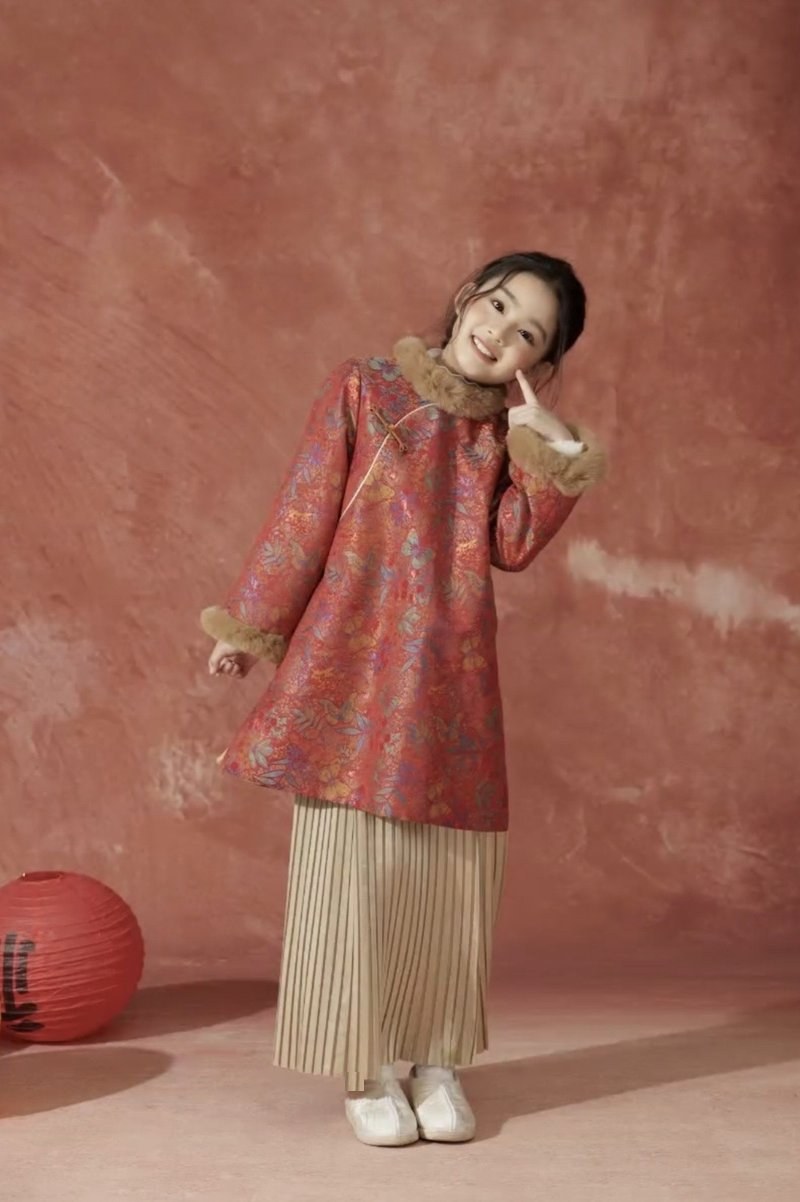
The photo carries the card, and festive clothes carry the photo. The reliable formula is one heritage piece worn with calm colors around it:
- One festive piece is enough. A red brocade vest or jacket over ordinary clothes reads clearly at card size and re-wears for the actual holiday — nothing gets bought for one photo. Families who want the full look can browse the collection page.
- Composition beats perfection. The outfits-and-lighting formulas — window light, seated poses, what colors photograph evenly — are in our holiday photoshoot outfit guide; the lantern-and-tangerine props that make a corner look intentional are in the photoshoot props guide.
- Let the child hold something. A red envelope, a mandarin, a paper lantern — hands with props produce natural expressions and fewer forced smiles.
Four Designs Kids Can Actually Help Make
- The folded classic. Red cardstock folded in half, a gold-pen goat or “fu” character on the front, the child’s greeting inside. Ten minutes, ages four and up.
- Thumbprint plum blossoms. Five ink thumbprints in a circle, a marker-drawn stem — plum blossoms bloom at New Year and every card comes out different.
- The photo-inset card. A smaller print of the card photo glued onto a folded red card with a gold-paper frame; even three-year-olds can manage the glue stick.
- The envelope-card hybrid. Decorate a red envelope, tuck a small note and a photograph inside — the craft doubles as gift wrapping. Five graded versions, from folded-paper to toddler coloring, are in our red envelope crafts guide.
The Classroom Version
Teachers planning a festival party can turn card-making into a station: pre-cut red cardstock, gold pens, printed greetings to copy, and a basket of goat templates. It pairs naturally with envelope folding at an adjacent table — the logistics section in our school party guide shows how the rotation works, and finished cards can be mailed to school partners or taken home for the family’s own relatives.
The Practical Three: Washing, Safety, Movement
- Washing — the photo shoot rarely leaves marks, but snack-time does: delicate cycle, cold to warm water, inside out for brocade and velvet, hung to dry. The full routine is in the wash-and-store guide.
- Safety — our children’s line is tested to GB31701-2015 Class A by a CNAS-accredited lab, the children’s clothing safety standard used in China, with sewn closures and no drawstrings at the hood or neck. The two-minute pre-photo check is in the toddler safety checklist.
- Movement — card-photo sessions mean sitting, standing, reaching for props and holding poses. Soft waistbands, wide trousers and sleeves with room keep children comfortable through take twenty.
Sizing in Centimeters and US Sizes
| Height (cm) | Approx. US size | Approx. age |
| 100 cm | 3T-4T | 3-4 years |
| 110 cm | 4T-5T | 4-5 years |
| 120 cm | US 6-7 | 6-7 years |
| 130 cm | US 8 | 8 years |
| 140 cm | US 10 | 10 years |
| 150 cm | US 12 | 12 years |
Order by height, allow room for a winter base layer, and when in doubt size up — the kids’ sizing chart explains the fit rule.
Frequently Asked Questions
Is it polite to send Lunar New Year cards if our family does not celebrate?
Yes, when framed as a greeting rather than a claim. “Wishing you a happy Year of the Goat” from a child’s class or scout troop is received the way a Christmas card from a non-Christian friend is — as kindness. Handmade cards from children are welcome in essentially any context.
Digital or printed — which do relatives prefer?
Grandparents abroad usually prefer printed; the local family group chat prefers digital. The sensible default is printed for the elders on your list, digital for everyone else, same photo for both.
What if we missed the before-New-Year window?
Send anyway. Greetings stay welcome through the full fifteen days, ending at the Lantern Festival on February 20, 2027 — a card that arrives mid-festival lands in the middle of the celebration, not after it.
Do the children need traditional outfits for the photo?
No — one festive piece is enough, and a red sweater photographs perfectly well. If you do want a piece, a vest or jacket over ordinary clothes is the affordable route that re-wears all season.
[…] One quiet tradition worth stealing from experienced families: date the child’s handmade pieces. A pencil note on the back of a paper cutting — name, age, year — turns a January craft session into a fifteen-year archive. Many families keep one box of New Year decorations that only the children’s pieces enter, and unpacking it each February becomes its own small ceremony. Paper fades and tears, so photograph the fragile ones flat against white card before they retire; the best of those photos graduate into next year’s New Year cards. […]