

Ask a parent what stops them from buying hanfu for a two-year-old and it is rarely the colors. It is the hardware. Rows of knotted frog buttons, a velvet skirt that sweeps the floor, a hood on a winter sweatshirt set — each one looks like a question mark when the wearer is still perfecting the art of running. Those concerns are reasonable, and most of them have clear, checkable answers. This guide walks through the four things that actually matter for toddler hanfu safety — closures, cords, hems and fabric — then ends with a 90-second checklist you can run on any piece, from any brand, before your child wears it out the door.
The Short Answer: What “Safe” Should Mean Here
Hanfu for kids is not a costume accessory; it is children’s clothing, and it should be judged the way you judge anything else your child wears all day. On its collection page, Little Hanfu states that every piece is CNAS-lab-tested to GB 31701-2015, China’s national safety specification for infant and child textile products, at Class A — the strictest of the standard’s three classes, and the only tier rated for direct skin contact by infants under 36 months.
In practical terms, Class A under GB 31701 sets a formaldehyde limit of 20 mg/kg or lower, requires a skin-friendly pH range, bans azo dyes that can release harmful amines, and sets color-fastness requirements so dye stays in the garment instead of on skin or drool. Just as relevant for toddlers, the same standard prohibits any cords or drawstrings in the head and neck area of clothing for children under seven. If a brand genuinely tests to GB 31701 Class A, neck-drawstring safety is already written in.
One verification tip applies everywhere: ask the seller for the lab report for the batch your garment comes from. Brands that actually test answer that question quickly and without hedging.
Frog Buttons (Pan Kou): A Closure Built for Small Hands
The knotted closures along a mandarin collar look ornate, but the engineering is plain. Pan kou are flat knots of cord or fabric piping, sewn down in matching pairs: a loop on one side of the placket, a knot on the other. They fasten by pushing the knot through the loop, which means nothing snaps off under toddler force and nothing dangles loose from the chest.
Compare that with small rigid buttons on children’s shirts. A button that pops off in a car seat or a crib is a choking risk for a child who still mouths objects. A flat, fully stitched frog button has no loose part to come off in the first place — and on styles like the wine-red velvet vest shown below, the closure sits flush against the placket rather than hanging.
 The flat, stitched frog-button closure on the SXY-DK26-32 wine-red velvet vest — flush to the placket, no dangling ties at the neck.
The honest caveat: sewn-on does not mean sewn-on forever. Thread fatigues in a hot wash and a toddler’s grip is persistent, so give every closure a firm pull test before the first wear and every few wears after laundering. It takes ten seconds. Also worth knowing: cross-collar styles — the wrapped, side-fastening neckline seen on many tunics and long tops — have no buttons at all, which makes them the simplest choice for a child who still explores fabric with their teeth.
Hoods and Drawstrings: The One Check Brands Cannot Do for You
Drawstring safety has two layers: what the standard requires, and what you should still check. Under GB 31701, clothing for children under seven may not have cords or drawstrings in the head and neck area at all, so a compliant under-7 garment should arrive cord-free at the hood. Check anyway — run a finger inside every hood and along the collar — because compliance ultimately depends on who made the garment.
For children seven and older, hoods do appear, often on casual pieces. The brand’s sweatshirt-based sets, for example, layer a jacquard vest over a plain hooded sweatshirt (style SXY-DK26-09 is built this way). US guidance from the Consumer Product Safety Commission on hood drawstrings is unchanged: cords at the hood or neck of kids’ outerwear can snag on slides, bus doors and playground equipment. If a piece arrives with a neck cord, pull it out entirely, or knot it short and tuck the ends. Waist drawstrings are acceptable — just tie them flat and short, well above the knee, so they cannot catch on a bike pedal.
Skirt Length, Pleats and the Squat Test
A floor-length skirt is a photo decision and, on a playground, a trip decision. For everyday wear, look for a hem that clears the top of the shoe by a few centimeters when the child stands. The traditional horse-face pleat (mamianqun) construction actually helps here: the deep pleats open with every stride, so a pleated skirt restricts walking far less than a straight pencil-style skirt of the same length would.
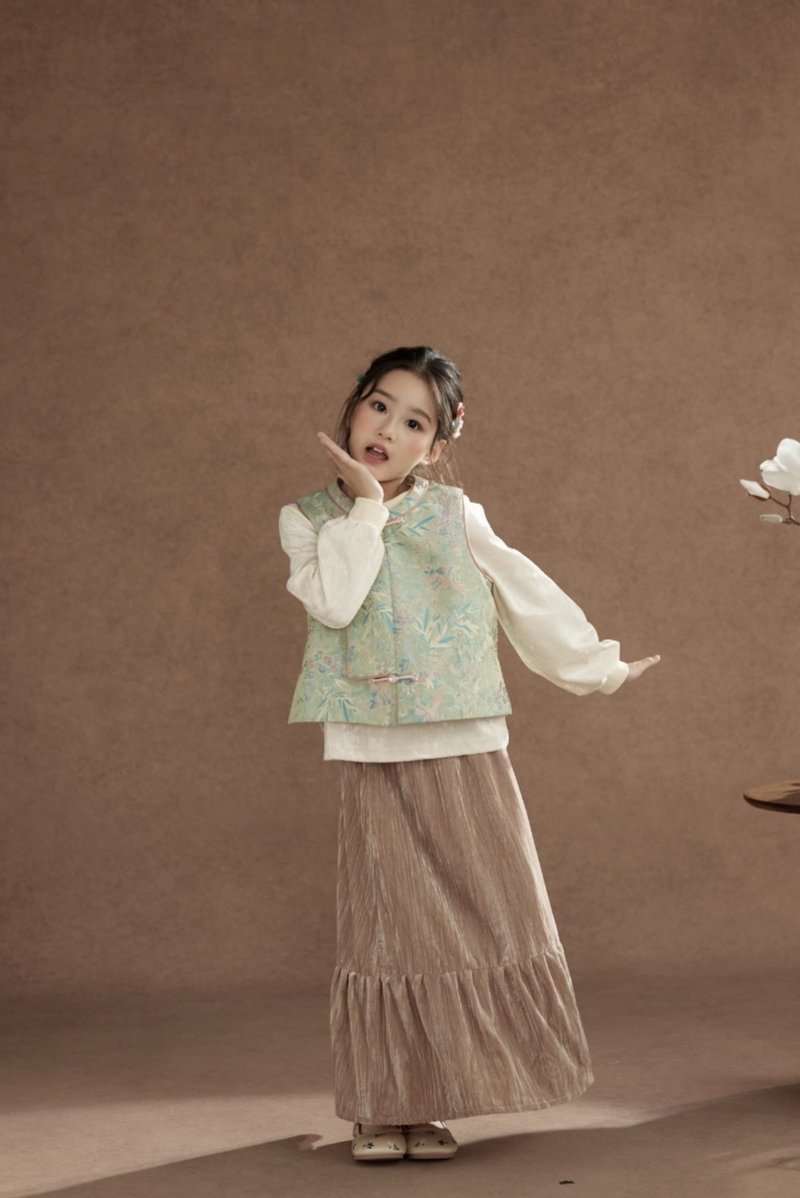 Everyday-testable length: the SXY-DK26-01 long velvet skirt clears the shoe, and the vest-plus-shirt layering leaves the arms free.
For serious climbing days, choose a trouser-based two-piece — several sets pair a cross-collar top with wide velvet trousers — or put shorts under the skirt and treat it as a dress. Then run the squat test: have your child squat fully and stand, walk ten steps, and climb one stair while you watch. If they need a hand to gather the skirt before any of those, save that piece for photos and ceremonies, and rotate it into everyday wear as they grow.
Fabric and Skin: What Class A Feels Like
Construction standards matter, but comfort is how a toddler votes. The brand describes its everyday approach on its about page as keeping “the mandarin collar, the horse-face pleat, the crossed lapel” while re-cutting them “in cotton and washable silk-blend fabric so a five-year-old can climb, spill, hug and sleep in them.” That is the right standard for this age group: breathable natural-fiber blends for base layers, structured brocade and velvet for outer pieces.
Velvet deserves a specific note for winter. It is a dense pile fabric with a soft hand on the face side, but the inside is what your child feels — so wrist-test the lining and the inside seams before committing. If your child flinches at certain synthetics or wool, have them press their inner arm against the fabric in the store or on arrival, and wash once before wearing to soften sizing and remove finishing residues.
The 90-Second Pre-Wear Checklist
- Pull every closure. Firm tug on each frog button, tie and decorative fastener. Anything that loosens goes back in the drawer, not on the child.
- Sweep for cords. Check the hood, collar and inside the garment. Under-7 pieces should have no neck cords at all; on older kids’ hoodies, remove or shorten any you find.
- Check the hem. Standing child, clear the shoe by a few centimeters. Floor-length is for held-or-seated occasions.
- Wrist-test the lining. Inner arm against the fabric, ten seconds, plus a check that no seam bumps or tags sit at the collar.
- Run the squat test. Squat, stand, ten steps, one stair. Watch, do not instruct.
- Inspect decorations. Appliqués, pom-poms and sequins should be firmly attached — and too large to swallow if your child still mouths things.
- Re-check after washing. Heat and tumbling loosen thread. Retire anything that fails the pull test twice.
Fit by Age: Centimeters First, US Ages Second
Toddler hanfu is sized by height in centimeters, not by age, which is actually safer: a child who runs big or small gets a garment that fits their body, not their birthday. The toddler-relevant rows of the size chart:
| Size Tag (cm) | Child’s Height | Approx. US Age | Approx. US Size |
|---|---|---|---|
| 90 cm | 85–95 cm | 2–3 years | 2T–3T |
| 100 cm | 95–105 cm | 3–4 years | 3T–4T |
| 110 cm | 105–115 cm | 4–5 years | 4T–5T |
| 120 cm | 115–125 cm | 6–7 years | US 6–7 |
The full height chart through 160 cm, with the one-size-up rule and its exceptions, is in our hanfu sizing guide. For safety purposes, remember that a size up mainly buys hem clearance and sleeve length; it does not fix a stiff zipper, a scratchy lining or a dangling cord.
Frequently Asked Questions
Can toddler hanfu go in the washing machine?
Everyday cotton and washable silk-blend pieces generally take a cold, gentle machine wash inside a laundry bag. Structured brocade, velvet and padded pieces prefer hand washing or spot cleaning — follow the garment’s care label, and close all frog buttons before washing so the knots do not catch.
Are frog buttons safe for a two-year-old who mouths everything?
They are stitched flat with no detachable parts, which removes the pop-off choking route that small rigid buttons carry. Keep up the pull test, and if your child is an enthusiastic chewer, cross-collar wrap styles eliminate closures entirely.
Is a long velvet skirt a trip hazard for new walkers?
For two- to three-year-olds, choose a mid-calf hem or trousers for anything beyond a lap photo. Floor-length velvet photographs beautifully in a held child’s session; it does not belong on a new walker’s free-range afternoon.
Can a padded hanfu coat be worn in a car seat?
Thick puffy coats compress in a crash, which loosens the harness. Dress your toddler in the thin layers of the outfit for the ride, buckle the harness snug, then put the coat on backwards over the arms or tuck a blanket around them. This mirrors standard US winter car-seat guidance and applies to any brand’s padded outerwear.
How do I confirm a piece really meets Class A?
Ask for the CNAS-lab test report for the batch and check the garment label for GB 31701 with the class marked. Sellers who test to the standard produce the paperwork quickly; hesitation is its own answer.
Once the checklist passes, what is left is the fun part: a child dressed in something with a story, who can still run. Browse the current kids’ hanfu collection, and if you retail childrenswear, our wholesale program carries the same safety-tested range.