

What exactly is a mamianqun?
If you have seen a child twirling in a pleated Chinese skirt with a flat, decorated panel at the front, you have already met the mamianqun (马面裙, pronounced “ma-myan-chün”). It is one of the most recognizable silhouettes in traditional Chinese dress, and it is quietly becoming a favorite among parents who want cultural clothing their kids can actually play in. The name is often translated as the “horse-face skirt,” which sounds odd until you know where it comes from — and once the structure clicks, everything else about it makes sense.
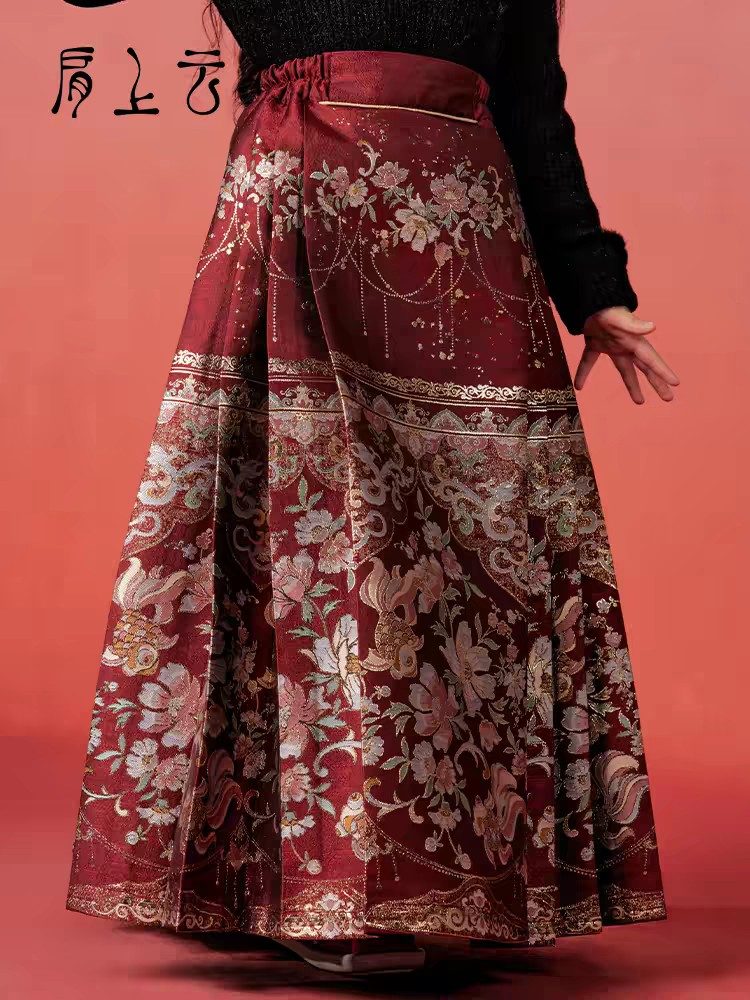
A mamianqun is a wrap-around skirt built from two flat, decorated panels — one at the front, one at the back — with deep pleats folded into the sides. When the skirt hangs still, you see the flat panel. When the child runs, the pleats open and close like an accordion, flashing the pattern underneath. It is a design that was solved centuries ago: structured enough to show ornament, loose enough to move in.
Why “horse-face”? The name, explained
The “horse face” has nothing to do with horses’ faces. In traditional Chinese architecture, a mamian — literally “horse face” — is the name for the flat, projecting section of a city wall between two bastions: a wide, standing panel of masonry. Early pleated skirts were woven with wide, flat panels rising like those wall faces above the pleated sides, and the nickname stuck. So “horse-face skirt” really means “the skirt with the standing panel” — a piece of military engineering vocabulary that ended up describing a child’s festive skirt. It is the kind of etymology kids love to repeat at school.
A short history, without the lecture
Pleated skirts with flat panels show up in Chinese records as far back as the Song dynasty, when a simple pleated wrap skirt became popular everyday wear. By the Ming dynasty, the mamianqun had matured into the form we recognize today — flat front and back panels, dense side pleats, woven waist ties — and it was worn by women and girls across social classes, from court ladies to merchant households. Through the Qing dynasty it kept evolving, with bolder borders, gilded patterns and richer color grounds.
Then, like much traditional dress, it stepped aside for modern clothing in the twentieth century. What is happening now is a revival: mamianqun has returned to daily fashion in China, worn with sweaters, denim jackets and sneakers, and parents abroad are discovering it as an alternative to costumes that fall apart after one wear. If your family is exploring Chinese clothing for a school event or the Lunar New Year, the mamianqun is the piece with the deepest everyday roots — it was streetwear in the Ming dynasty long before anyone called it that.
How the panels and pleats actually work
Here is the whole trick of the garment. The two flat panels — usually called the “skirt doors” — carry the decoration: woven brocade motifs, embroidered borders, gold thread. They sit at the front and the back, where eyes go. The sides are packed with knife pleats, sometimes in a contrasting fabric or a subtler pattern, which are what give the skirt its swing. The waist closes with long fabric ties instead of zippers or buttons, so the fit adjusts as the child grows.
That structure explains the skirt’s signature move: stand still and you see a calm, flat panel of pattern; take off running and the pleats bloom. Kids discover this within about four minutes of putting one on, and then do it on purpose for another twenty.
Mamianqun, qipao, or just “a pleated skirt”?
Parents often mix these up, and it matters when you are shopping. A qipao is a fitted one-piece dress with a standing collar and side closures. A mamianqun is a two-piece system: skirt plus top, with the skirt doing the cultural heavy lifting. And a regular Western pleated skirt has pleats all the way around, with no flat decorated panel at all — pretty, but a different garment. If you want a fuller comparison table, we broke down hanfu vs qipao vs tang suit for kids in an earlier guide. The short version: if the front is flat and decorated while the sides pleat, you are looking at a mamianqun.
The kids’ version: what actually changes
An adult mamianqun can weigh a surprising amount — layered brocade, dense pleats, long hems. A children’s version is not a scaled-down copy; it is a re-engineering. At Little Hanfu we keep the mandarin collar, the horse-face pleat and the crossed lapel, and re-cut them in cotton and washable silk-blend fabric so a five-year-old can climb, spill, hug and sleep in them. That is not marketing decoration — it is the entire design brief. Here is what to look for when you judge any kids’ mamianqun, ours or anyone else’s:
1. A waist that gives
Children grow in spurts and eat big lunches. Look for a soft elastic waist or generous self-fabric ties rather than a fixed fitted band. Tie waists also mean the skirt survives a growth spurt instead of being outgrown at the waistband first.
2. A hem that respects playground physics
Full-length festive hems are beautiful on a stage and hazardous on stairs. A kids’ mamianqun should end at mid-calf or lower shin — long enough for the silhouette to read clearly, short enough that a running child is not stepping on it.
3. Pleats that survive the wash
Cheap pleats are heat-set into synthetic fabric and relax into a wave after two washes. Pleats sewn or pressed into cotton-rich fabric hold their memory far longer. Ask how the pleats are made; it is the single best predictor of whether the skirt still looks right next season.
The three questions parents always ask
Can it go in the washing machine?
For everyday cotton and cotton-blend kids’ mamianqun, yes — cold water, gentle cycle, inside a laundry bag, then hang dry and the pleats settle back as the fabric dries. Brocade and velvet pieces, and anything with heavy gold thread, deserve the hand-wash-or-dry-clean treatment instead. When in doubt, follow the sewn-in label, and read our full guide on how to wash and store kids’ hanfu before the first wash — the storage half matters just as much for pleated skirts, which should hang, never fold, on a clip hanger.
Is it safe for a toddler or preschooler?
The mamianqun is one of the safer traditional garments for small children because it has no small buttons down the front and no cords at the neck — the closure is a wrapped waistband with flat ties. What you still want to check: that decorative elements are sewn flat rather than glued, that the ties knot away from hanging reach, and that the hem is clear of the floor. Our complete toddler hanfu safety checklist covers buttons, drawcords and sleeve length in detail.
Can they actually move in it?
Yes — the pleated sides are the whole point. A well-cut children’s mamianqun has a stride allowance built into every step, because the pleats expand. Watch a child in one on a playground: they squat, climb and sprint, and the skirt simply opens and closes. It is a better design for movement than many stiff party dresses sold for weddings.
Sizing: measure in cm first, age second
Chinese kidswear sizes by height in centimeters, which trips up US and UK parents used to age labels. Measure your child’s height, then use this conversion — and when a child sits between two sizes, size up; the tie waist forgives it:
| Height tag | Approx. US size |
|---|---|
| 100 cm | 3T–4T |
| 110 cm | 4T–5T |
| 120 cm | 6–7 years |
| 130 cm | 8 years |
| 140 cm | 10 years |
| 150 cm | 12 years |
Our complete cm-to-US sizing chart explains the “size up” rule and how each of our silhouettes fits.
Two easy ways to style it
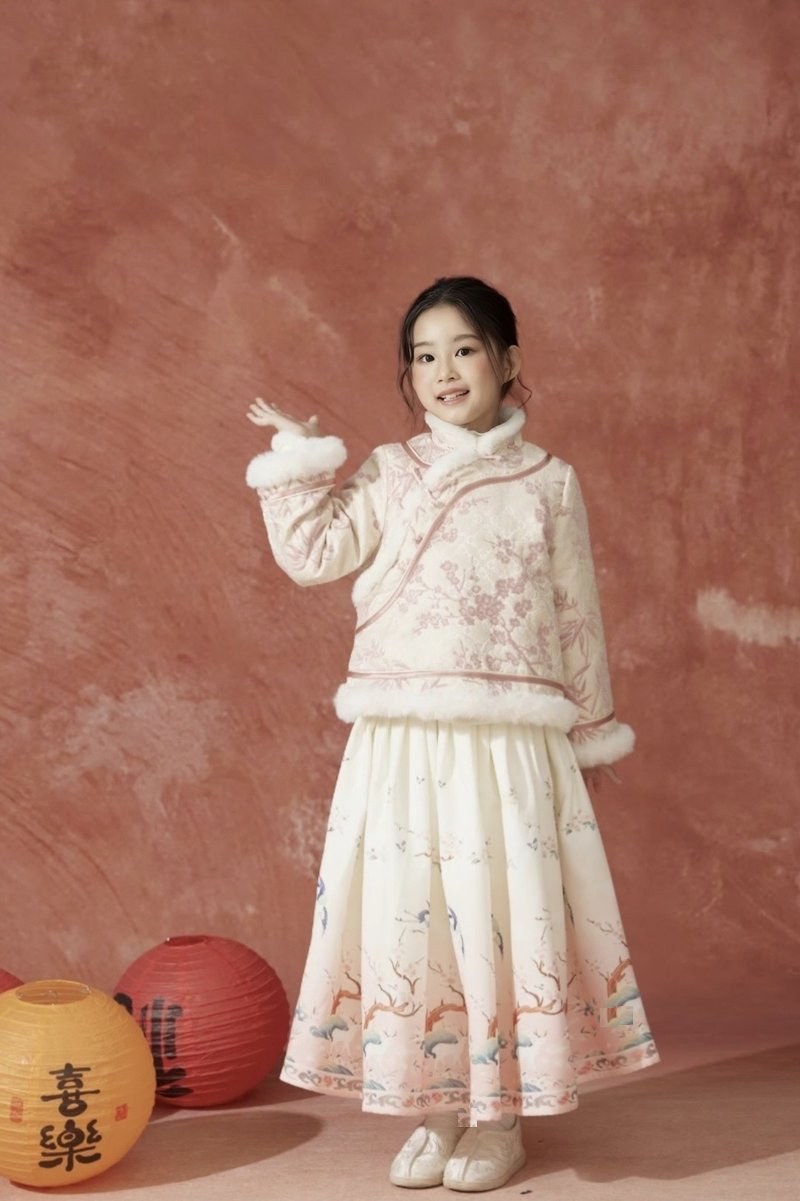
Everyday: plain fitted long-sleeve tee or turtleneck under the skirt, sneakers below. The flat panel does the talking; everything else stays quiet. Festival: a padded jacket with fur trim over the skirt for winter events, hair in two buns with a single ribbon. For formal occasions like weddings, check our guide on what a child should wear to a Chinese wedding — the etiquette on colors is more nuanced than “red everywhere.”
Frequently asked questions
What does “mamianqun” mean in English?
It translates literally as “horse-face skirt.” The name comes from traditional city-wall architecture, where the flat panel between two bastions is called a “horse face” — the skirt’s flat front panel resembles that standing face above the pleats.
Is a mamianqun the same as a qipao?
No. The qipao is a fitted one-piece dress; the mamianqun is a two-piece outfit built around a pleated wrap skirt with flat decorated panels. They are different garments from different tailoring traditions, and many families own both.
Can my child machine-wash a mamianqun?
Cotton and cotton-blend versions: yes, cold and gentle, in a laundry bag, hung to dry. Brocade, velvet or gold-thread versions: hand wash or dry clean. Always defer to the sewn-in care label.
What goes on top of a mamianqun?
Traditionally a jacket or ao over the skirt. Modern kids wear anything fitted — a plain sweatshirt, a turtleneck, or a jacquard vest, which is exactly how our current sets pair it.
What age is a kids’ mamianqun for?
Size by height, not age. Our chart runs 100–150 cm, which covers roughly ages 3 to 12. Because the waist ties, the skirt fits a wide band within each height tag.
Is red the only acceptable color?
Red is the festive favorite for Lunar New Year, but mamianqun come in celadon, ivory, navy, plum and more. For weddings, avoid upstaging colors per the family’s preference — the flower-girl guide above covers the etiquette.
Ready to see one in person? Browse the current children’s mamianqun and hanfu collection, or read more about who we are and how we build kid-proof traditional clothing.
[…] Already read the theory? Skip ahead — everything here links back to our deep-dive on what a mamianqun actually is. […]