
Browse photos of children in hanfu and one silhouette keeps appearing: a top, a long skirt, nothing else. No closure running down the chest, no fixed waist seam, just two pieces that move like play clothes and photograph like heritage. That two-piece is the ruqun, and it is arguably the most worn – and least explained – style in the entire hanfu family. If you are choosing a first traditional outfit for a daughter, this guide covers what a ruqun is, where it comes from, how it differs from the mamianqun and the qipao it is often confused with, and what to check on sizing and care before you order.
What a ruqun actually is
Ruqun (pronounced “roo-choon”) is a two-character word that is exactly what it says. The ru is the upper piece – a jacket or blouse, cross-collared or stand-collared, tucked or left loose. The qun is the skirt, a long wrap or pull-on piece that falls to the ankle. Worn together, they make a complete outfit; that is the whole grammar of it. Because the two pieces are separate, the fit is forgiving in a way one-piece garments are not: a child can outgrow the top before the skirt, or the reverse, and the outfit survives.
Two details are worth knowing before you shop. First, the collar: traditional ruqun tops use a cross collar that lays left over right, a convention with centuries of history behind it, though many modern children’s versions use a stand collar with a single frog button for easier dressing. Second, the waist: classic skirts tie with long fabric sashes, while kidswear versions usually hide an elastic waistband inside the same silhouette – the look stays traditional, the dressing routine becomes a ten-second job for a five-year-old.
How old is the ruqun?
Older than almost everything else in a child’s wardrobe. Top-and-skirt dressing appears in Chinese tombs and texts reaching back to the Warring States and Han dynasties, more than two thousand years ago, and by the Tang dynasty (618-907) the ruqun had become the defining everyday outfit of Chinese women – worn high on the waist or even above the ribs, with sleeves and hem widths swinging in and out of fashion like hemlines do today. Song dynasty portraits, Ming dynasty paintings, family photographs from a century ago: in each generation, there it is again, a top and a skirt.
That long record is worth mentioning to children, because it gives the outfit a story that a costume does not have. A ruqun is not a dress-up choice invented for a festival; it is a shape real people wore to school, to market and to their grandmother’s house for a very long time – which is also why it moves like real clothes. It was engineered by daily life.
Ruqun vs. mamianqun vs. qipao
The three names get mixed up constantly, and understandably: all three are traditional Chinese clothing, and all three show up in holiday photos. The short version:
- Ruqun is the two-piece system itself – any traditional top worn with a matching skirt. It is a category, not a single garment.
- Mamianqun, the “horse-face skirt”, is a specific kind of qun: a pleated skirt with flat decorated panels at front and back. Our mamianqun explainer for kids covers its structure in detail. A jacket worn over a mamianqun is still, broadly, ruqun-style dressing – the ruqun is the sentence, the mamianqun is one famous word in it.
- Qipao is a one-piece dress with a fixed seam from collar to hem, a much younger style that took its modern shape in the 1920s. Our comparison of hanfu, qipao and tang suit for kids lays all three side by side in one table.
For parents the practical difference is the most useful one: two pieces size, wash and hand down separately, which is exactly why the ruqun shape dominates children’s hanfu – ours included.
Why the two-piece works so well for children
Four reasons families keep landing on this silhouette, in roughly this order:
- It grows with the child. An elastic-waist skirt covers two or three growth spurts on its own, and a long-cut top hides the years when trousers would peek out. Outfits that survive longer get reworn – at school events, next New Year, in next year’s photos.
- It mixes and matches. The skirt pairs with an ordinary sweater on a normal Tuesday; the top lifts a plain dress for a recital. One purchase becomes several outfits, which matters in a children’s wardrobe far more than in an adult’s.
- Bathroom independence is preserved. Ask any preschool teacher: a skirt with an elastic waist versus a one-piece dress is the difference between “I did it myself” and an emergency call. Two-piece traditional clothing keeps the ceremony without taking away the independence.
- It layers for winter. A thermal under the top, a vest over it, leggings under the skirt – the silhouette accepts layers gracefully, which is what makes it a four-season garment instead of a June one.
What it looks like in a winter line
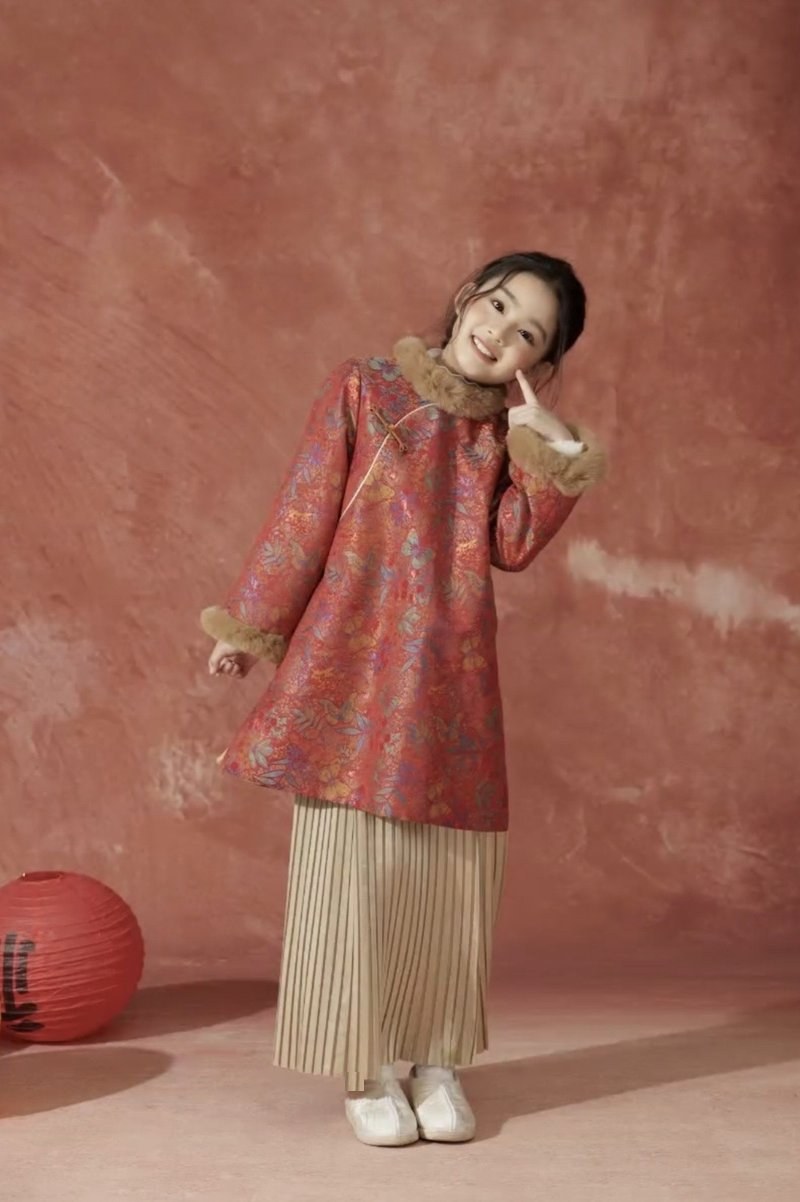
The ruqun shape is easy to spot once you know it: top plus skirt, in this case a red-gold brocade tunic with a plush collar over a pleated gold skirt – the look families have been choosing for Lunar New Year photos for several seasons running, and the one our red-gold brocade girls’ set page describes piece by piece.
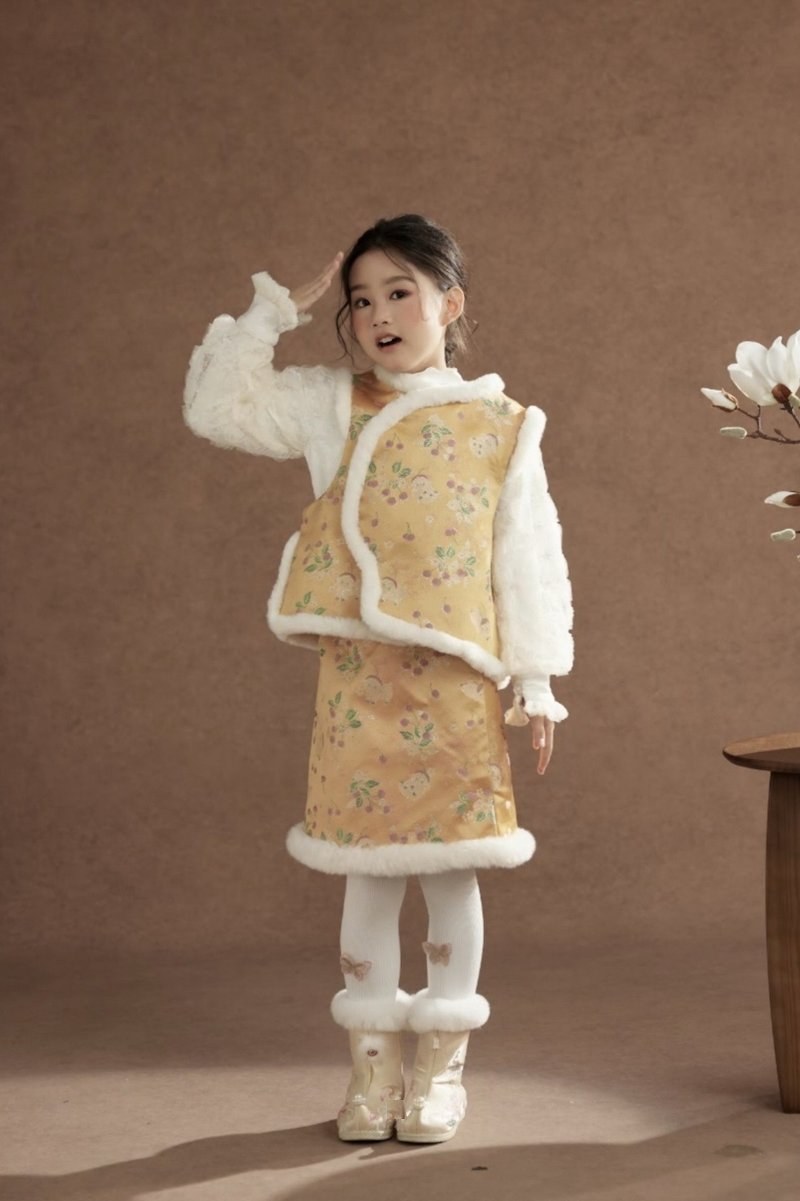
The same two-piece logic runs through the whole winter range with different top pieces: a brocade vest instead of a tunic, as in the goose-yellow blossom vest and skirt set, or a vest layered over a soft hooded sweatshirt, as in the light yellow-green jacquard vest and hoodie set – a modern reading of the same idea, with the skirt doing the traditional work. Every one of them is ruqun dressing underneath the styling.
The three questions parents always ask
Can it be machine washed? Most of our two-piece sets are built around washable everyday fabrics: the cotton-blend tops and skirts go in the machine on cold, gentle cycle, inside out, and hang dry. Jacquard and velvet pieces keep their finish longest with a cold hand wash. The full routine – including how to store everything between seasons – is in our washing and storage guide.
Is it safe for a small child? Our children’s line is lab-tested to GB 31701-2015 Class A, the Chinese national safety standard for children’s textiles. There are no drawstrings at the neck, closures are sewn flat, and long sashes – where a design uses them – tie outside the arm’s reach of play. The full pre-wear routine is in our toddler safety checklist.
Can they actually move in it? Two-piece hanfu is the most movement-friendly traditional silhouette precisely because nothing is joined: the skirt swings, the top shrugs, and a child can run, squat and sit cross-legged without pulling anywhere. If an outfit cannot survive a playground, it does not belong in a child’s wardrobe, whatever the occasion.
Sizing a ruqun: order by height in centimeters
Hanfu children’s sizing runs on height, not age. Measure your child barefoot from heel to crown, then use the chart:
| Child’s height | Approx. US size |
|---|---|
| 100 cm | 3T-4T |
| 110 cm | 4T-5T |
| 120 cm | 6-7 years |
| 130 cm | 8 years |
| 140 cm | 10 years |
| 150 cm | 12 years |
If the measurement sits between two rows, size up – the elastic waist and the long-cut tops are designed for growing room, and a slightly long skirt on a seven-year-old is next year’s correctly-sized skirt. The full logic is in our cm-to-US sizing chart, and for the youngest wearers our first hanfu for baby guide starts from the smallest stock size.
Frequently asked questions
What does ruqun mean?
Two Chinese characters: ru, the top, and qun, the skirt. The name is the outfit description – a traditional Chinese top-and-skirt set worn by women and children for over two thousand years.
Is a mamianqun a ruqun?
Close: the mamianqun is a particular type of skirt, and when it is worn with a jacket the combination follows the ruqun two-piece logic. The difference is the skirt’s construction – pleats plus flat decorated panels – which our mamianqun explainer illustrates.
What age is a ruqun suitable for?
Any age that can walk comfortably in a mid-calf or ankle-length skirt – in practice from around age two (our smallest stock size is 100 cm, roughly US 3T-4T) through the whole elementary range.
How do I choose between a ruqun and a one-piece dress?
Choose the two-piece for growth room, mixing with existing clothes and bathroom independence; choose a one-piece when you want a single decision in the morning and a very fixed silhouette for photos. Many families end up with one of each.
Can a ruqun be worn for occasions other than Lunar New Year?
That is its natural habitat, historically – it was daily wear, not festival wear. School cultural days, birthdays, family photos and ordinary weekends are all fair game; our school cultural day guide shows it doing exactly that job.
Two pieces, one long story. If the ruqun is the shape you were picturing, the collection page lists the current winter sets by color family, and the size chart above does the rest.