
Lunar New Year morning has a soundtrack, and it is children’s voices. Long before the lanterns go up, kids in new clothes move through the house saying the phrases they have been practicing for weeks – to grandparents first, then to aunts and uncles, then down the phone to relatives on the other side of the world. For parents raising kids outside China, the greetings are the most rewarding part of the holiday to prepare: short enough for a toddler to learn, meaningful enough that elders remember them for months. This guide collects the phrases that matter, the gesture that goes with them, the red envelope manners around them, and a practice plan that fits a busy family calendar before February 6, 2027.
When children give greetings
The greetings season runs the full fifteen days of the festival, but a child’s moments are predictable. New Year’s Eve dinner is the warm-up – greetings to the people at the table. New Year’s Day morning belongs to the household and the elders; many families schedule it right after everyone dresses in new clothes. The days after follow visits: the second day traditionally goes to the mother’s side of the family, and the sequence of visits varies by family and region, so follow your hosts’ calendar rather than any fixed rule. Video calls have added one more moment that matters – children greeting grandparents abroad – and it is often the easiest one, because a screen feels lower-stakes than a living room full of adults. By the Lantern Festival the greetings wind down, and the festival closes with lanterns rather than words.
The core phrases, with pinyin
A child does not need many phrases – three or four, said clearly, outperform a memorized list delivered in a mumble. These cover every room a child will walk into:
- Xin nian kuai le – “Happy New Year.” The universal greeting, safe with anyone of any age. This is the phrase to teach first.
- Gong xi fa cai – literally “congratulations and may you prosper.” The classic greeting to adults, and the phrase adults most enjoy hearing from children. Close relatives may tease back with a playful “where is my red envelope?” exchange – let the adults start that game, not the child.
- Shen ti jian kang – “wishing you good health.” The phrase for grandparents and great-grandparents, and the one that lands hardest with them. Health, not wealth, is what elders wish to hear from the youngest generation.
- Wan shi ru yi – “may everything go as you wish.” A graceful all-purpose blessing that works at dinners and formal visits alike; school-age children can carry this one comfortably.
- Zhu laoshi xin nian kuai le – “Happy New Year, Teacher.” If your child greets teachers before the break, this small phrase teaches the habit of greeting elders by role.
One direction worth knowing in reverse: adults greet children with xue ye jin bu (“progress in your studies”) or kuai gao chang da (“grow up quickly”). When a child hears those, the expected reply is a thank-you – xiexie – and, very often, a red envelope follows.
The gesture that goes with the words
The traditional greeting gesture is the gong shou salute: one hand open, the other a loose fist, held together at chest height with a small nod or bow. It takes a five-year-old about a minute to learn and looks charming even when slightly lopsided. For toddlers, a simple bow or a deep nod with hands together does the same work. Customs around the exact hand arrangement vary by region and family, and hosts will correct a child gently at most – warmth lands louder than precision. What matters is that the words and the body move together: a child who bows while saying gong xi fa cai has performed the whole ritual, whatever the hand details.
Red envelope manners in four steps
Greetings and red envelopes are two halves of one exchange, so the receiving side deserves a quick rehearsal too. The short version: receive with both hands, say the greeting phrase and then thank you, and do not open the envelope in front of the giver – hand it to a parent to hold. That is nearly all a child needs. Our family guide to New Year traditions walks through the full etiquette, including what parents do with the envelopes afterward.
A two-week practice plan
The phrases stick when they arrive one at a time. Two weeks before New Year’s Day, start with one phrase at breakfast each morning – xin nian kuai le the first day, gong xi fa cai the second, and so on, cycling back through the list. Add the gesture in the second week so words and bow fuse together. Rehearse once on a video call with a willing relative; a real audience does more than any mirror. By New Year’s morning the child owns three phrases cold, and the rest are bonus material. Families who want to wrap the practice into a bigger countdown can fold it into our holiday activity calendar, which paces one small tradition per day through December and January.
New clothes for the greeting moment
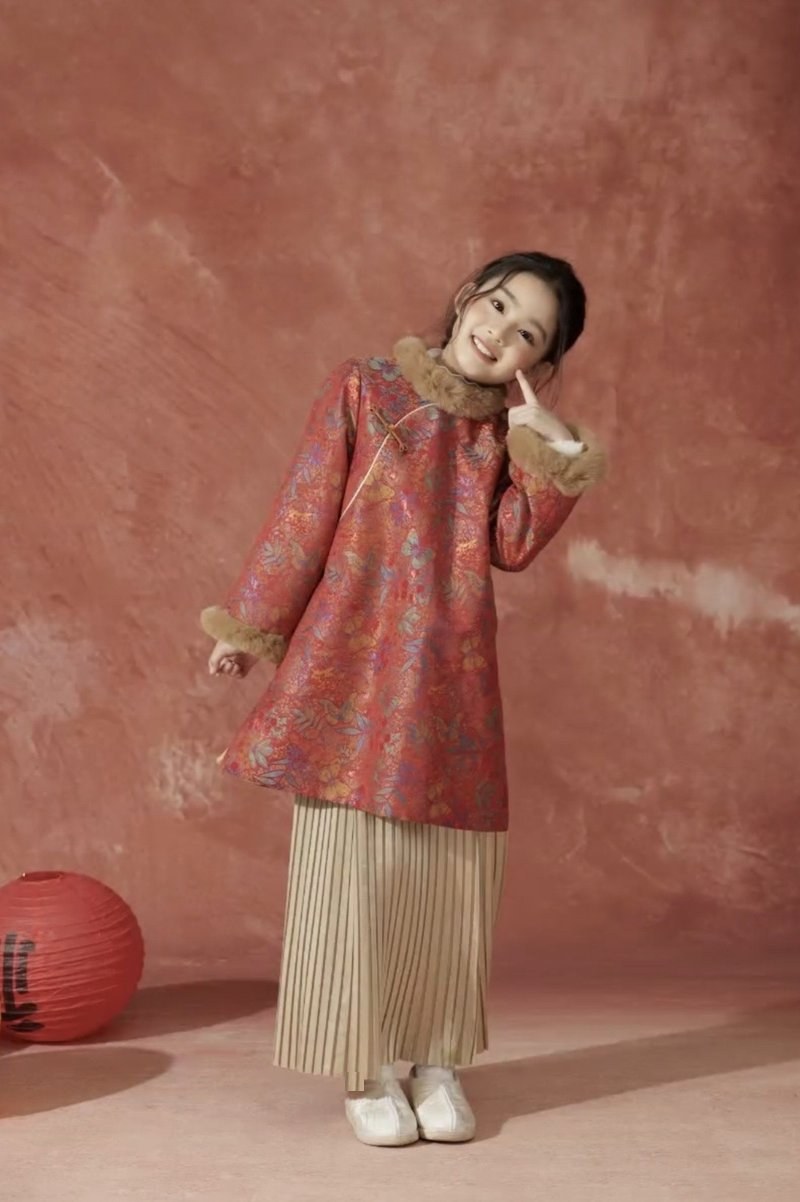
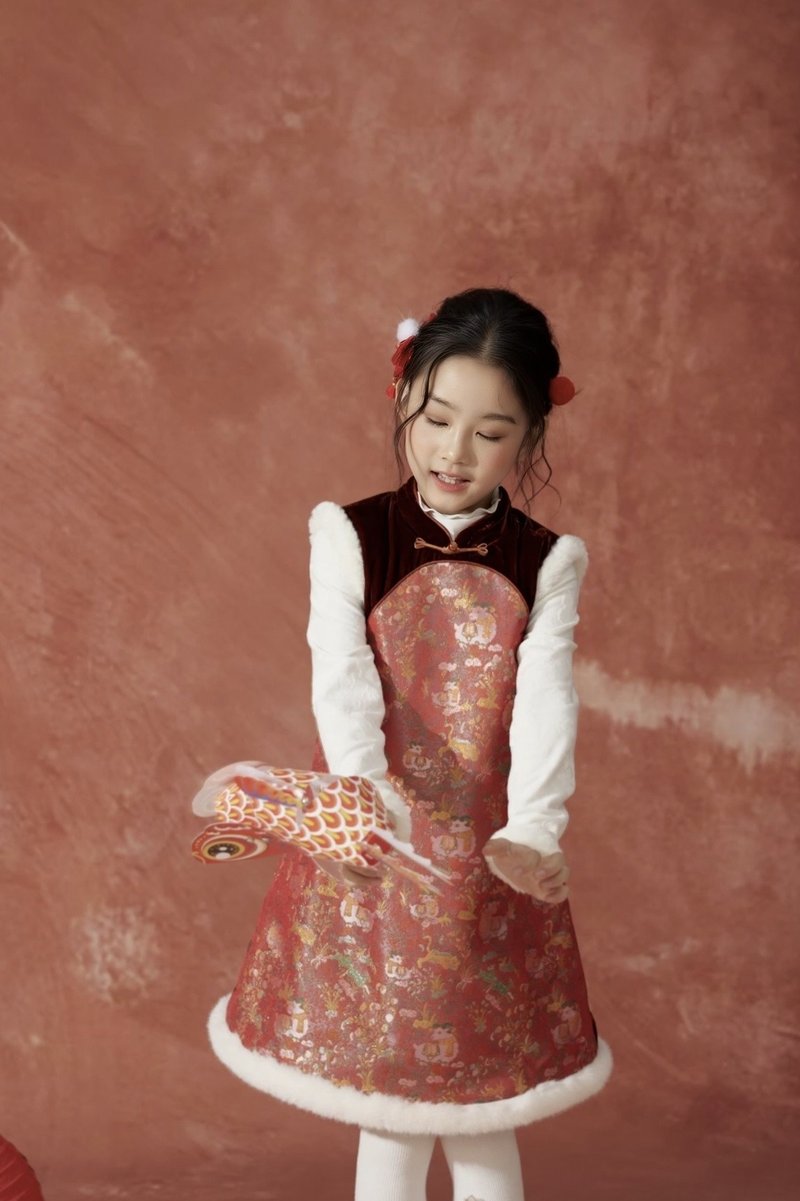
The phrase is the child’s line; the outfit is the stage. A child who walks out in festival red on New Year’s morning gets the room’s attention before saying a word, and the greeting lands on an audience that is already smiling. Practical notes for the moment itself: the bow and the gong shou salute need nothing from the clothes – a cross collar and soft waistband do not bind when a small body bends – so a child in traditional dress can move exactly as freely as the ritual asks. The children’s line is lab-tested to GB 31701-2015 Class A, the Chinese national safety standard for children’s textiles, with no drawstrings at the neck and closures sewn flat, so there is nothing to adjust or worry over mid-greeting. And after the fifteen days, everything takes a cold, gentle machine cycle inside out and hangs to dry – the full routine is in our washing and storage guide. Our toddler New Year outfit guide helps choose the outfit itself, down to a first festival set at 100 cm (about US 3T-4T).
Frequently asked questions
What if my child is too shy to say anything?
Lower the stakes, not the expectation. Let the child bow and smile while a parent says the phrase – that is a complete greeting for a three-year-old – and rehearse on video calls before the living-room moment. Shy children usually join in by the second or third house once the ritual feels familiar rather than performed.
Can non-Chinese families use these greetings?
Yes, and the gesture is noticed. Hosts read the effort, not the accent; a family that shows up in festive clothes and offers gong xi fa cai with a bow will be welcomed into the exchange. Nothing in the custom is closed to guests – it is built to be passed on.
Do children need to kowtow?
In some families, yes – a formal kowtow to grandparents on New Year’s morning is still practiced, sometimes with a cushion brought out for the occasion. In many others a bow is the whole requirement. The honest rule: follow the host family’s lead. If you are guests and unsure, a deep bow with the gong shou salute is respectful everywhere.
What should a child say when receiving a red envelope?
The greeting phrase first, then thank you – xiexie – with both hands on the envelope. Grandparents often hand the envelope over only after the phrase, which is why the practice plan drills the pairing of words and hands together.
Which outfit works for greeting day?
Whatever lets the child bow without fuss and survive a full day of visits – that is the whole brief. For the dressiest reading, families pair the greeting moment with the looks in our New Year dinner outfit guide, and browse the full red season range on the collection page.
Phrases fade by February; the photo of your child mid-bow in festival red does not. Teach three phrases, one gesture, and let the outfit do the rest of the talking – that is a New Year’s morning everyone in the room keeps.
[…] bow. Rehearse once on a video call so the first real performance is not the first attempt. Our guide to New Year greetings for kids has the full phrase list with pinyin, the greeting gesture, and the practice plan – and the […]
[…] greet the eldest relatives by name with a new-year wish. A handful of phrases is enough, and our CNY greetings guide for kids gives five age-appropriate ones with pronunciation and a two-week practice […]
[…] movement and sizing. If your child is still learning what to say when they hand one over, our CNY greetings guide for kids covers the phrases and the […]
[…] naturally: the child delivering greetings, the red envelope handover, the tea being poured. Our greetings guide doubles as a photo-moment script — the bow and the two-handed envelope exchange photograph […]