

Every winter rack needs one red dress that is not a costume — the piece a girl wears to the holiday card session in December and the family dinner in February without anyone calling it dress-up. The DK25-10 is that piece: a red dress in fine corduroy with an embroidered cape collar, gold piping, and a pair of ivory tassels that move when she does. It looks elaborate in photos and behaves like a favorite dress in person. Here is what it is made of, where the cape collar comes from, and what boutiques should know before ordering it for the winter season.
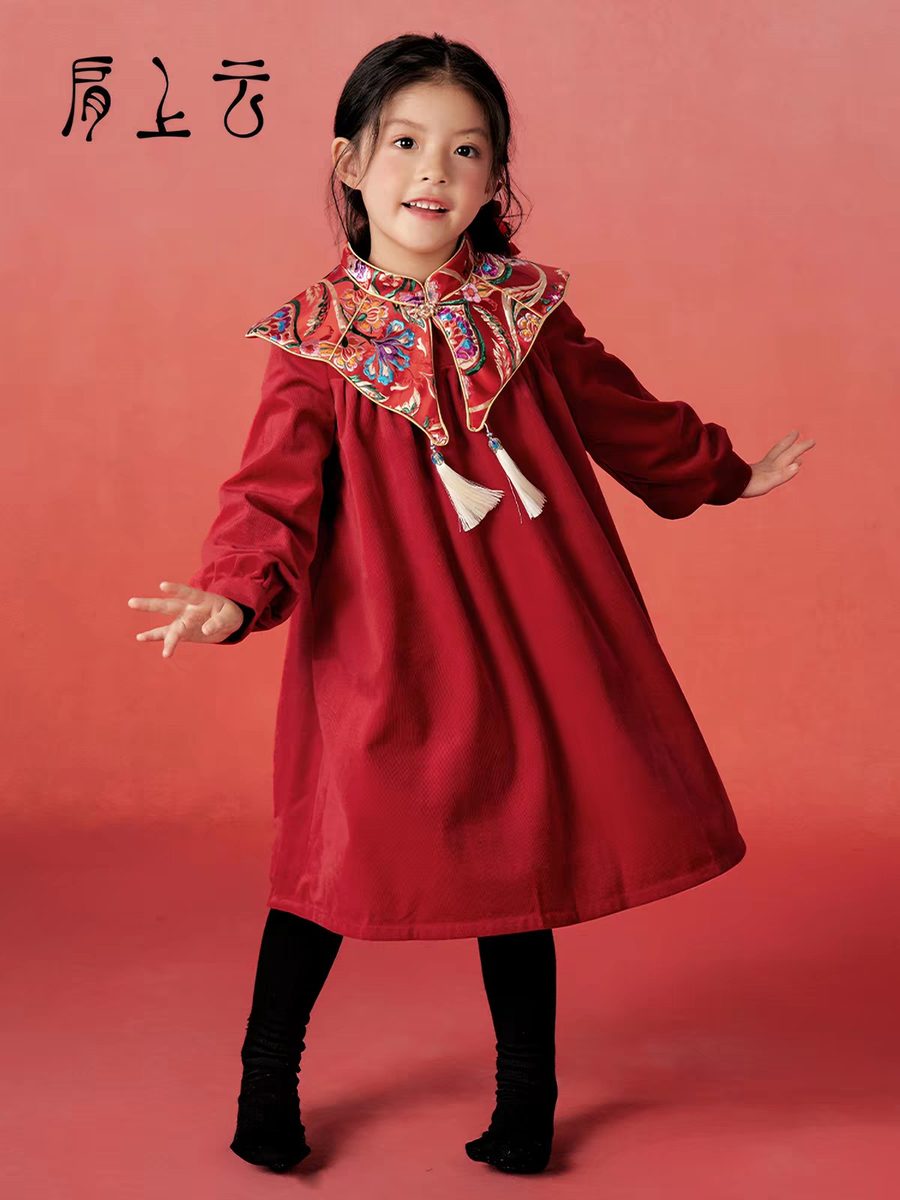
The Cape Collar: A Yunjian Inheritance
The collar is a simplified yunjian — the “cloud shoulder,” a shaped shoulder cape that Chinese dressmakers embroidered for children and brides for centuries. In traditional dress it carried protective symbolism: a layer of embroidered motifs worn over the shoulders, the part of a child a grandmother’s eye always returned to. On this dress the idea survives in a wearable form — a red collar-cape embroidered with colorful blossoms in a traditionally inspired palette, edged in gold piping and finished with two soft tassels at the front closure. The child gets the drama of a cape without a separate layer to put on, take off, and lose; the photo gets a focal point at the face, which is exactly where a portrait wants it.
The Dress: Fine Corduroy, Real Winter Weight
The body is a long-sleeved dress in fine-wale corduroy, a fabric choice that earns its place on practicality: corduroy is warm without bulk, photographs with a soft depth that flat weaves lack, and shrugs off the wrinkles that ruin satin on a car ride to grandmother’s house. The cut is an A-line that falls below the knee, gathered at the shoulders for swing, with room for a long-sleeve shirt and thick tights underneath in deep winter. There are no zippers and no back buttons — a parent dresses a child in this in one motion, and a child old enough to dress herself can manage it too. It is a full-day garment: school event in the morning, photos at noon, dinner after, no change of clothes required.
How It Styles Across the Season
With black tights and ordinary shoes, the dress is complete — the cape collar replaces jewelry, scarves, and every accessory a child will lose by January. It carries three distinct occasions without restyling: the family holiday photoshoot, where the red reads festive against winter backgrounds; school cultural days and winter concerts, where one strong piece outperforms a full costume; and Lunar New Year on February 6, 2027, where red is the color of the season — our article on why children wear red explains the tradition she is participating in. For boutiques, that triple duty is the sales argument: one SKU, one rack position, a four-month wearing season from December through Spring Festival, with our CNY red-outfit guide covering the late-season demand.
The Sibling Piece: An Embroidered Cape in Ivory
For families who want the cape look without the red, the ivory cape below is the collection’s other take on the same idea — teal and blue floral embroidery, plush trim at the hood edge and hem, worn open over a mint pleated dress. Stocked together, the two cover both holiday color strategies: the girl who wants to be the red in the photo, and the one who wants to be the winter in it.

Sizing: Read the Chart in Centimeters First
The collection is sized by height in centimeters; the US columns are translations, not the starting point:
| Size tag (cm) | Child’s height | Approx. US age | Approx. US size |
|---|---|---|---|
| 90 cm | 85–95 cm | 2–3 years | 2T–3T |
| 100 cm | 95–105 cm | 3–4 years | 3T–4T |
| 110 cm | 105–115 cm | 4–5 years | 4T–5T |
| 120 cm | 115–125 cm | 6–7 years | US 6–7 |
| 130 cm | 125–135 cm | 7–9 years | US 7–8 |
| 140 cm | 135–145 cm | 9–10 years | US 10 |
| 150 cm | 145–155 cm | 11–12 years | US 12 |
| 160 cm | 155–165 cm | 13–14 years | US 14 |
Children at a boundary should size up — the A-line carries growing room gracefully, and the full cm-to-US sizing guide covers skirt length and torso measurements piece by piece.
Care and Safety
The collection is produced to China’s GB31701-2015 Class A children’s textile safety standard — the class intended for garments worn against young children’s skin — and the closures here are stitched-through with no loose small parts; our toddler safety checklist lists what to check on any garment in this category. For care, corduroy takes a gentle machine cycle well; the embroidered cape collar prefers a gentle hand wash to keep the stitching raised and the tassels smooth. Cold water, mild detergent, air dry — the full routine is in our wash-and-store guide. A garment that survives February in wear-ready condition is the one that gets worn again in April, which is how a seasonal buy becomes a regular one.
For Boutiques: Ordering Notes
Wholesale terms on our wholesale page: sets run $45–120 with a 12-piece minimum per style, shipped by DHL or FedEx. Made-to-order pieces take three to five weeks and bulk production six to ten, so a winter buy placed now covers both the Christmas trade and the Lunar New Year peak in early February. The dress pairs naturally with the collection’s padded jackets and mamian skirts for a complete holiday wall; the about page outlines the design studio behind the collection, and the collection page lists current availability.
The red cape dress solves the oldest problem in children’s holiday wear — clothes that photograph like an occasion and wear like an ordinary good dress. Measure, order inside the window, and let her be the red in the photo.