
Every October and November, the same note comes home from school: book week is coming, and your child has chosen a character. For a remarkable number of children — and plenty of boys as well as girls — the choice is Mulan, the warrior who took her father’s place in the army and came home a legend. The costume aisle answer is a printed polyester dress that will survive the school parade and nothing else. There is a better road: build the look from a real children’s hanfu, a garment cut and embroidered for actual children by a Chinese design studio, and you get a costume that photographs beautifully on the day and then keeps working as winter clothing straight through to Lunar New Year on February 6, 2027. Here are three looks that work, what the story behind them adds to a book week presentation, and the practical details — comfort, washing, sizing — that decide whether the outfit lasts the whole school day.
Why Mulan Keeps Winning Book Week
The character children know from film is built on much older ground: the Ballad of Mulan, a poem from the Northern Dynasties period roughly fifteen centuries old, in which a girl dresses as a soldier, serves twelve years beside comrades who never notice, and is offered a minister’s post she turns down to go home. Teachers like the story because it rewards courage and family loyalty without a villain to carry the plot; children like it because the heroine gets armor, a sword, and a horse. A costume built on a poem also gives a class presentation real material — unlike a generic princess, Mulan comes with a text your child can quote. That matters in a book week context, where many schools now ask children to say something about the character they are wearing.
Look 1: The Dragon Jacquard Set
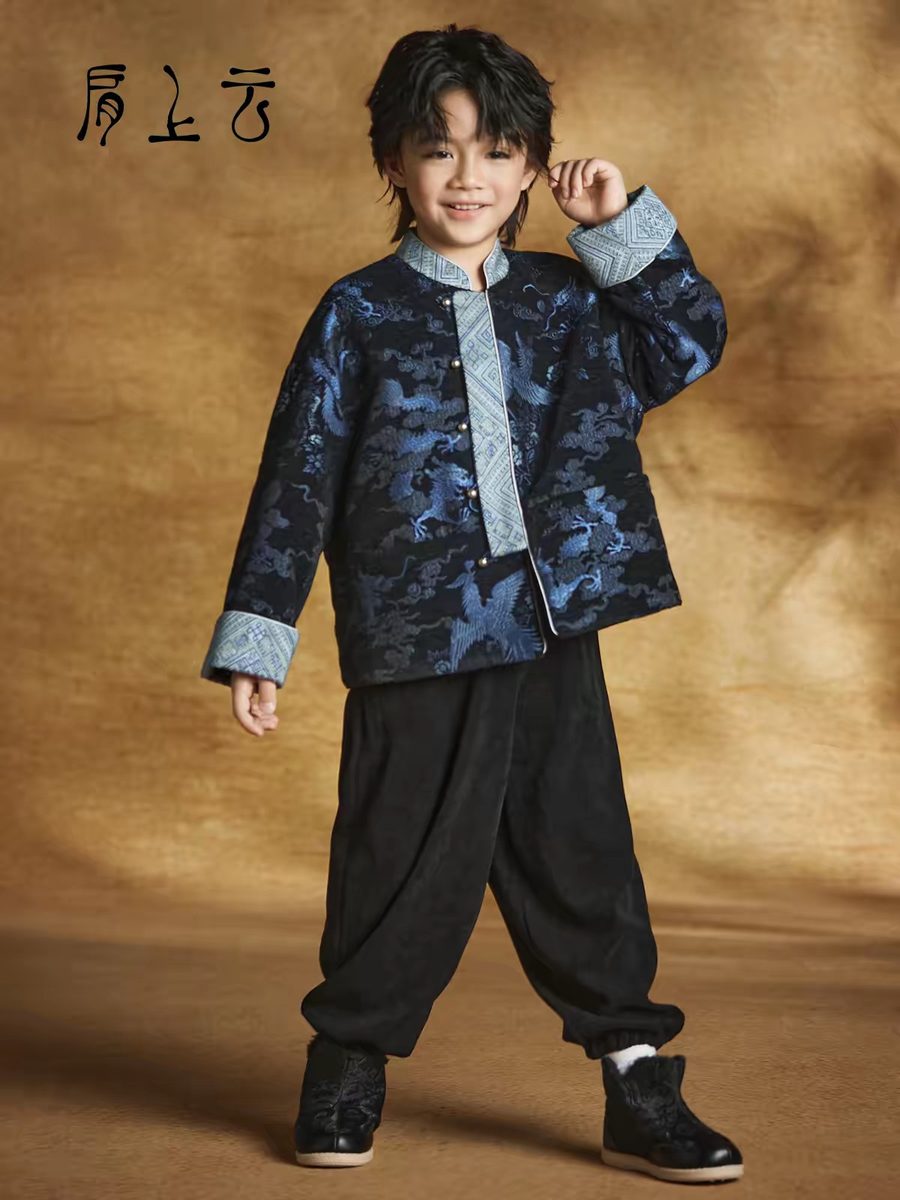
The strongest warrior-era look in the collection is a navy jacquard boys’ set: dragons and clouds woven through the fabric in blue, a stand collar, light-blue geometric trim running down the placket and around the cuffs, and loose black trousers for running. In the photo below it reads as exactly what a child imagining Mulan’s army wants — dark, dramatic, and ready for a quest. It is also a real garment, not a costume shell: the jacket is padded for cold mornings, the trousers have an elastic ease that survives playground duty, and dragons on children’s festive clothing are a traditional auspicious motif in Chinese dress, worn at New Year and birthdays for generations. The set suits the tang-suit sizing approach too — sized by height, worn with ordinary shoes.
Look 2: The Red Cape Dress
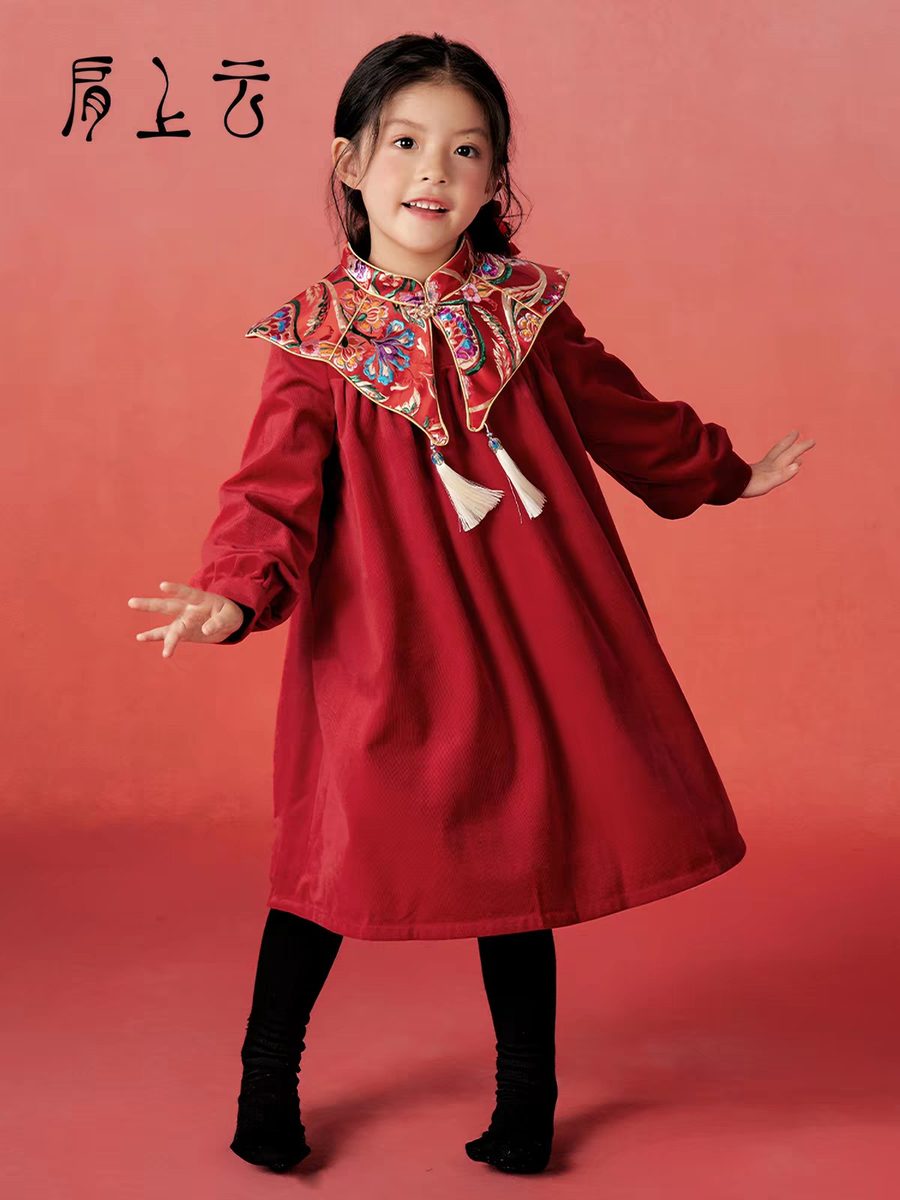
If your child’s Mulan is the snow-mountain kind — the red cape in the forest — the shortest path is our red cape dress spotlight: a fine-corduroy red dress with an embroidered cape collar and a pair of ivory tassels. It delivers the cape silhouette without a separate cloak to lose at recess, and the embroidered collar does the work a costume usually needs a whole accessory bag for. For the school parade, add nothing; the piece is complete as it is. Afterward it goes straight into the winter rotation as an ordinary good dress, which is the whole argument for building a book week look on real clothing.
Look 3: The Brocade Celebration Two-Piece
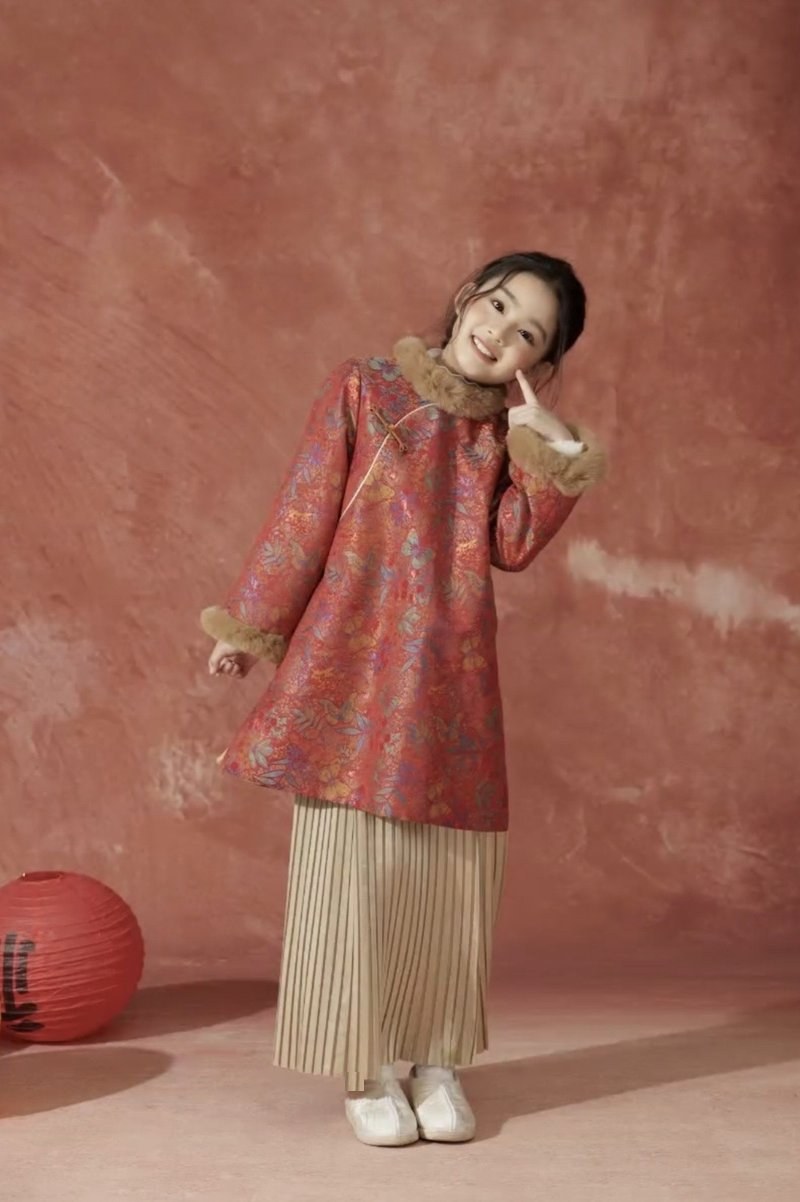
For the family who wants one purchase to cover book week and everything after it, the red-gold brocade two-piece below is the workhorse: a cross-collar tunic in woven brocade with plush fur at the collar and cuffs, worn over a long pleated skirt in soft gold. On parade day it is the banquet-scene outfit — the one Mulan wears when she comes home. In December it is the holiday-portrait outfit; in February it is the Lunar New Year outfit, and our CNY red-outfit guide picks up that half of the season. Three occasions, one SKU on the rack — boutiques stock it for exactly that reason, at wholesale terms starting at 12 pieces per style.
Dressing as a Character, Not a Costume of a Culture
Schools increasingly draw this line, and it is the right one: a child dressing as Mulan is dressing as a character from a Chinese classic, the way a child might dress as a knight from an English ballad — with curiosity and respect, not as a caricature of a culture. Three habits keep it on the right side of the line. Ground the costume in the actual story, and let your child retell a scene for the class. Wear the real thing: a hanfu designed for children by Chinese designers carries the tradition it comes from, while a generic “Asian-inspired” mashup usually gets the details wrong. And talk about what the motifs mean — plum blossoms for perseverance, dragons for strength and good fortune — because a child who can explain the embroidery is never wearing a stereotype. Our school cultural day guide goes deeper on presenting hanfu in classrooms.
Comfort: The Full School Day Is the Real Test
A costume that comes off at morning break has failed at its one job. The test is the squat: a child who can squat, sit cross-legged on a classroom rug, and climb the play structure without adjusting the outfit will wear it all day happily. The collection is cut for children in motion — A-line skirts that swing without tripping, trousers with real room, armholes made for raised hands — and it is produced to China’s GB31701-2015 Class A children’s textile safety standard, the class intended for garments worn against young children’s skin. Frog buttons are stitched through the fabric, and there are no drawstrings at hoods or necks; the full list is in our toddler safety checklist.
The Machine-Wash Question
Book week means bus seats, morning tea, and whatever the art room does to a sleeve — so the outfit needs to be washable, not dry-clean-only. Everyday quilted cotton-blend pieces go in the machine on a gentle cycle; brocade and plush-trimmed pieces prefer a gentle hand wash to protect the pile and the embroidery. Cold water, mild detergent, air dry throughout. The complete routine, including how to store pleated skirts and padded pieces between wears, is in our wash-and-store guide — and the layering that keeps the outfit comfortable in a cold school hall is in our winter layering guide.
Sizing Without Panic
Children’s hanfu is sized by height in centimeters, not by US age labels. Measure your child, match the row, and read the US columns as translations:
| Size tag (cm) | Child’s height | Approx. US age | Approx. US size |
|---|---|---|---|
| 90 cm | 85–95 cm | 2–3 years | 2T–3T |
| 100 cm | 95–105 cm | 3–4 years | 3T–4T |
| 110 cm | 105–115 cm | 4–5 years | 4T–5T |
| 120 cm | 115–125 cm | 6–7 years | US 6–7 |
| 130 cm | 125–135 cm | 7–9 years | US 7–8 |
| 140 cm | 135–145 cm | 9–10 years | US 10 |
| 150 cm | 145–155 cm | 11–12 years | US 12 |
| 160 cm | 155–165 cm | 13–14 years | US 14 |
Children at a boundary should always size up; hems are cut to be worn lower as a child grows, and growing room is invisible in a parade. The full cm-to-US sizing guide covers skirt length, sleeves and torso piece by piece.
Life After the Parade
The quiet advantage of a hanfu book week costume is that November is not the end of it. The same pieces carry into the holiday-photo season — our family photoshoot formulas use exactly these layers — and then into Lunar New Year on February 6, 2027, when red and gold are simply the color of the season; the tradition behind the red makes a nice second chapter for the same story your child told in October. For a gentler pink alternative for girls, our peach blossom padded dress spotlight covers the collection’s other winter one-piece.
Frequently Asked Questions
Is it appropriate for a child who isn’t Chinese to dress as Mulan?
Dressing as a specific character from a well-known story, in a real garment from that tradition, and being able to say something about the story is widely read as appreciation rather than caricature. The pitfalls to avoid are the generic mashups — a kimono-style robe with chopsticks in the hair is where book week costumes go wrong.
What should kids wear under hanfu for a cold school day?
A thin cotton long-sleeve shirt and thick tights or leggings under dresses; a snug base layer under two-piece sets. Everything layers beneath the hanfu, so the collar line stays clean for the parade photos.
Will the outfit survive a whole school day?
Run the squat test before the day: if your child can squat, sit on the rug, and climb without adjusting anything, the outfit will last. A-line cuts, real armholes, and stitched-through frog buttons are designed for exactly this.
Can the pieces be machine washed after book week?
Quilted cotton-blend pieces take a gentle machine cycle; brocade and plush-trimmed pieces do better with a gentle hand wash. Cold water and air drying throughout — details in the wash-and-store guide.
How far in advance should we order?
In-stock collection pieces ship within days; made-to-order styles take three to five weeks and bulk production six to ten, per the terms on our wholesale page, shipped by DHL or FedEx. Order in late October and the outfit covers book week, the holidays, and Lunar New Year.
Do you ship internationally?
Yes — DHL and FedEx on the timelines above. Boutique buyers will find wholesale terms starting at 12-piece minimums at $45–120 per set on the wholesale page.
A book week costume that comes with a fifteen-hundred-year-old poem, a real garment tradition, and a second life as winter clothing is a better answer than anything hanging in the costume aisle. Measure the child, run the squat test, and let the story do the rest. The fabrics and the studio behind the collection are described on the about page, and the collection page lists current pieces from 90 cm up.