
Ask any parent who has just bought a child’s first hanfu what they are quietly worried about, and the answer is rarely the outfit. It is the hair. A collar that frames the face and a silhouette with no waistline put all the attention on the head – and most of us have exactly one hairstyle in our morning repertoire. The good news: traditional Chinese children’s hairstyles are simpler, older and more forgiving than they look, and the accessory kit they need costs almost nothing. This guide covers the classic styles, the safe accessories to use, three styles you can build in under five minutes, and what to avoid, especially for toddlers.
Why hair carries the outfit
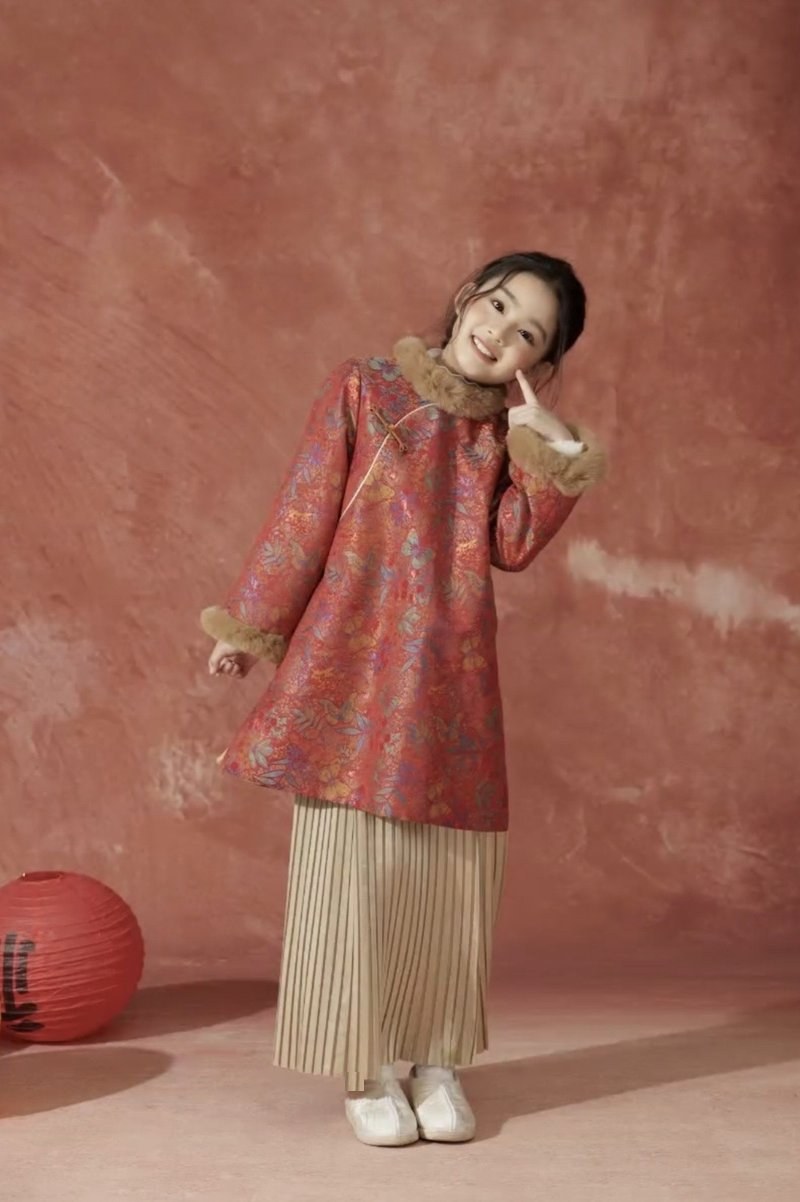
Modern children’s clothes are built around the shoulders and the hem; traditional Chinese dress is built around the collar. A cross collar or stand collar draws the eye upward to the face and neckline, which means loose hair falling over the collar visually cuts the outfit in half. Tied-up hair does the opposite: it opens the collar line, shows off the buttons or embroidery where they sit, and keeps every strand out of the dumpling dip at dinner. For photos the effect is even more direct – families who do one thing for their holiday shoot, do the hair.
The classic children’s style: double buns
If you have seen a painting or figurine of a Chinese child from almost any dynasty, you have seen the double bun – two small symmetrical buns, one above each ear. Called shuangya ji in classical texts, literally “double ya buns” after the sprouting-horn shape, it was the everyday hairstyle of Chinese children for well over a thousand years: Tang dynasty murals show it, Song dynasty paintings show it, and it appears on children in family photographs from the early twentieth century. Historically the two buns marked childhood itself – the word for a young child in classical Chinese, zong, refers to exactly this hairstyle.
That history is convenient for parents, because the double bun is also one of the easiest traditional styles to build. It flatters fine, short and flyaway hair better than a single sleek bun, it survives a school day, and it reads as traditional without a single accessory. Everything you add beyond it is decoration.
The safe accessory kit
Traditional hair accessories for adults include metal hairpins and ornate combs, and museum-grade versions are beautiful – but a child’s kit should be built from soft and flexible pieces. What actually works:
- Fabric-covered elastics and ribbon hair ties. The workhorses. Choose soft, snag-free elastics in colors matched to the outfit; ribbon ties add a trailing bow that photographs well from the back.
- Fabric bows and cloth-covered clips. A single bow above each bun is the classic finishing touch. Clips with flat metal-free backs stay put through play.
- Soft headbands. A wide fabric band keeps short hair and bangs off the face while the buns grow in – useful for the two-to-four-year-old range.
- A fine-tooth comb and a spray bottle. Not accessories in the decorative sense, but the two tools that make five-minute styles possible. Damp hair parts cleanly and buns hold better.
What to skip for young children: metal hairpins of any kind, tight decorative combs that dig behind the ear, and small jeweled clips that can come loose. Hair accessories follow the same logic as the rest of children’s clothing – nothing sharp, nothing that sheds small parts, nothing that leaves marks. Our toddler safety checklist covers the clothing side of that routine in detail.
Three styles, step by step
Double buns (about five minutes). Damp the hair with the spray bottle and comb it straight back. Part it down the middle from forehead to nape. On each side, gather hair into a high ponytail just above the ear, twist the length into a loop, and wrap it around the elastic into a bun; secure with a second elastic or a ribbon tie. Fine hair holds better if you backcomb the ponytail lightly once before twisting. Finish with a small bow at the base of each bun.
Half-up with ribbon (ninety seconds). The workday option. Section the top half of the hair from temple to temple, smooth it back, and tie it at the crown with a ribbon long enough to trail. This suits the stand-collar vest sets especially well, because it keeps the collar line clear while leaving length visible at the back.
Single low bun with fabric band (three minutes). For longer, thicker hair or for girls who dislike buns above the ears: comb everything back into a low bun at the nape, then add a soft fabric headband from the hairline back. This is the calmest, most grown-up reading of the three, and it sits beautifully under a hooded layer.
Matching accessories to the outfit
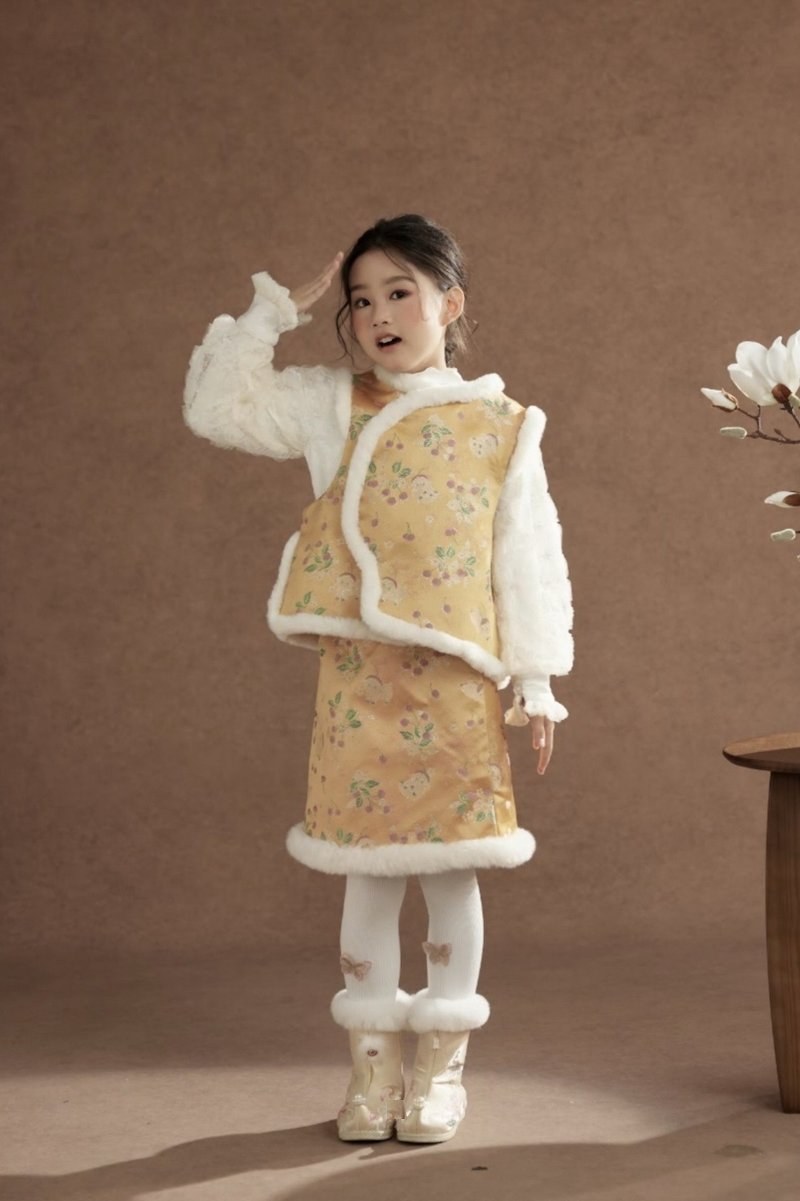
The simplest rule: pull one accent color from the garment, not the ground color. If the dress is red with gold motifs, use gold or cream accessories – red-on-red disappears. For blue-and-white outfits, deep navy ribbon reads richer than white. Green sets such as the soft-green vest families love in winter photos take cream or warm tan accessories beautifully. When in doubt, plain cream ribbon matches nearly everything in a traditional palette.
The three questions parents ask
Will the hairstyle survive an active day? Yes, with one adjustment: build buns on slightly damp hair and let them dry in place – damp-set hair keeps its shape far longer than dry hair sprayed after the fact. Half-up styles with a good elastic survive a full school day; add the headband for the under-fives whose fine hair slides.
Are accessories safe for a toddler? Stick to the soft kit above: fabric elastics, cloth bows, headbands. No pins, no metal combs, nothing beaded. Check after wear that nothing has come loose, and take the whole set out before naps and car seats – the same remove-before-sleep habit as necklaces and clips in any children’s wardrobe. The garments themselves are lab-tested to GB 31701-2015 Class A, the Chinese national safety standard for children’s textiles, so nothing on the outfit sheds or snags either.
How do I care for the fabric accessories? The same load as the outfit. Fabric bows and headbands go into a laundry bag on a cold, gentle cycle with the garments, following the routine in our washing and storage guide, and air-dry flat. Ribbon with wired edges is the one piece to hand wash.
Frequently asked questions
Do girls need a traditional hairstyle to wear hanfu?
No. A clean ponytail or a plain braid looks perfectly natural, and plenty of families stop there. The traditional styles earn their keep for festivals, school events and photos – they finish the outfit the way the right shoes finish it, not because anything is required.
What is the children’s double bun called?
Shuangya ji, the double sprout-bun. It is the hairstyle children in classical Chinese paintings wear, and using the name is a small culture lesson in itself – children enjoy knowing their hairstyle is a thousand years old.
How much hair is enough for double buns?
Surprisingly little. Chin-length hair makes small buns, and very fine hair can be secured with soft covered elastics plus a headband for the front. If the buns will not hold yet, the half-up style with a ribbon is the honest answer for this season.
Can boys wear traditional hairstyles too?
Historically boys wore the double buns exactly as girls did, and a neat short cut with a clear side part reads traditional under a collar. Boys’ holiday looks depend far more on the outfit – our boys’ hanfu guide for Lunar New Year covers that side.
What about babies and first birthdays?
Keep it minimal: a soft headband and, if there is enough hair, a single tiny bun. The first hanfu for baby guide covers the outfit side, and the same gentle logic applies on top.
The kit works across the whole size range, too – the same soft elastics finish a toddler’s very first outfit at 100 cm (about US 3T-4T) as a ten-year-old’s at 140 cm (US 10), because the styles scale with head size far more gracefully than clothes scale with height. Hair is the cheapest upgrade in a traditional outfit and the one people remember. Build the double buns once, keep a small soft accessory kit by the comb, and the whole wardrobe – from the current collection to next year’s sizes – gets a finishing touch that takes five minutes. For the full styling context, our holiday photoshoot outfit guide shows the complete looks from collar to bow.