

The family holiday photograph has quietly become the most planned outfit decision of the winter — more deliberate than the office party, more photographed than the school concert. And every December, parents face the same fork: another set of matching pajamas, or something the grandparents will actually ask about. A children’s hanfu is the second road. It photographs with real color and texture, it works equally well for Christmas cards and Lunar New Year portraits (February 6, 2027 this cycle, so one purchase covers both), and unlike most seasonal buys it stays in rotation long after the shoot. Here are four outfit formulas that shoot beautifully, what each looks like in person, and the practical details — sizing, comfort, washing, order deadlines — that decide whether the outfit makes it to the camera at all.
Why Hanfu Photographs Well
Three reasons, all visible in the finished photo. First, structure: standing collars, crossed front lines and pleated skirts hold their shape on camera instead of collapsing the way soft knitwear does. Second, pattern with meaning — plum blossoms, cranes, garden flowers — which gives the close-up crops something to talk about. Third, scale on small people: children wear silhouette the way adults wear accessories. A cape or a pleated skirt that would look theatrical on a parent looks like a story on a six-year-old. The result is a photo that looks styled without a stylist.
Idea 1: An Embroidered Cape Over a Pleated Dress
The most camera-friendly winter formula is a cape layer over a soft hanfu dress. The piece below is an ivory cape embroidered with teal and blue garden flowers, finished with plush trim along the hood edge and hem, worn open over a mint pleated dress with frog buttons. In photos it reads as a page from a storybook; in person it is simply the warmest layer in the outfit, which matters when the shoot happens outdoors in December. Because the cape ties at the neck and opens at the front, it goes on over everything in seconds — a real advantage with children whose patience for getting dressed runs about ninety seconds.

Idea 2: A Brocade Tunic Two-Piece for Indoor Shoots
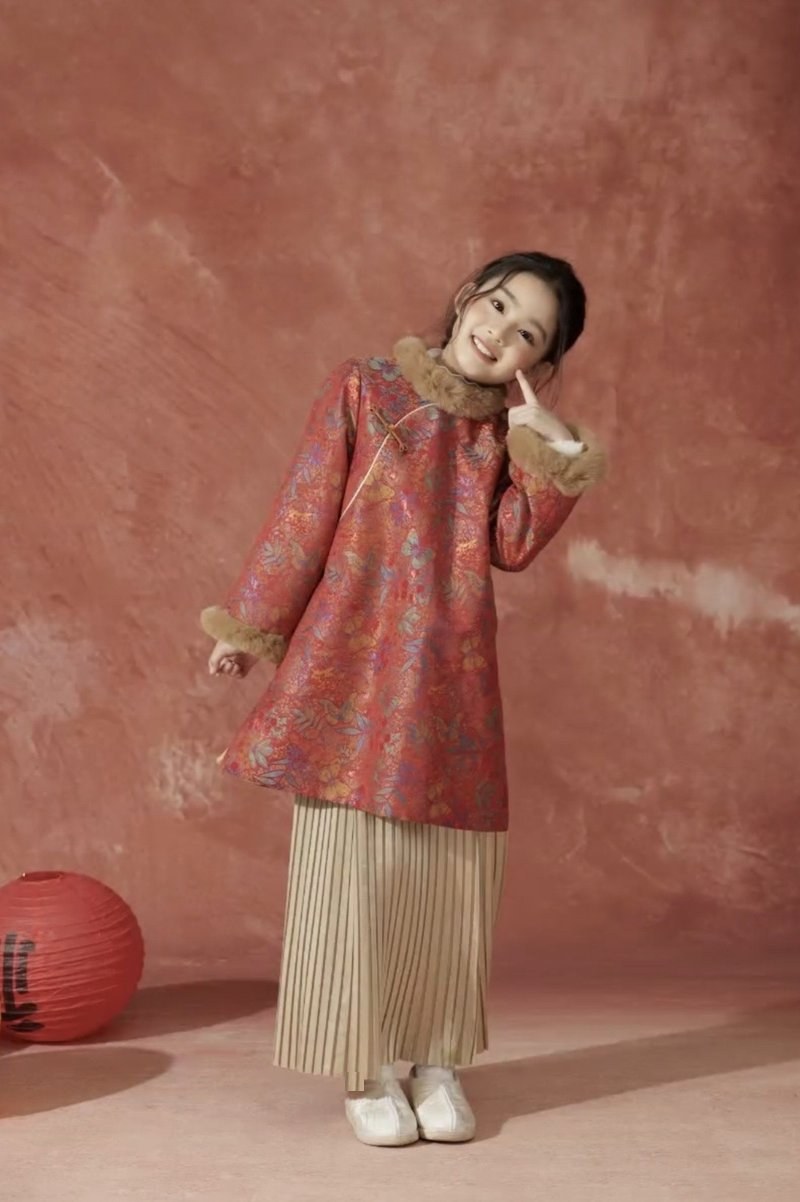
For indoor sessions — the living room, a studio backdrop, the family dinner table — a two-piece in woven brocade gives the richest texture on camera. The set below pairs a red-gold floral brocade tunic with a cross collar and plush fur at the collar and cuffs, worn over a long pleated skirt in soft gold. The longer tunic line flatters both seated and standing poses, and brocade catches window light in a way flat cotton cannot. It is also a cut with one of the wider age ranges in the collection, so it suits the six-to-ten crowd who have outgrown toddler silhouettes but still want in on the dress-up.
Idea 3: Parent-Child Matching, Done Subtly
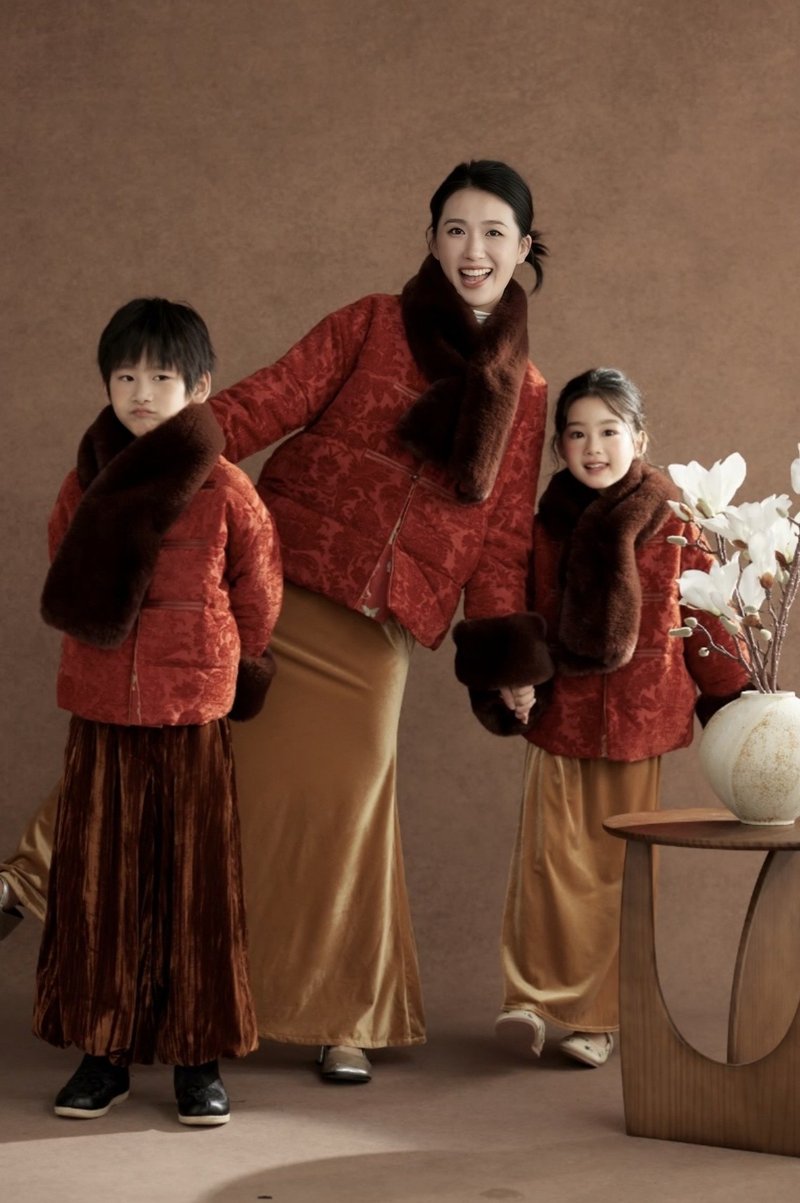
Matching family outfits photograph best when the match lives in fabric and color rather than in identical costumes. The set below is the model: adult and child versions of a red brocade padded jacket with a plush scarf collar and cuffs, worn over amber velvet skirts — the same design language at two scales, which reads as coordinated instead of costumes. Our family matching guide explains how the sets line up across sizes, and the parent-child Lunar New Year roundup adds combinations aimed at the second half of the season — which, again, arrives on February 6. One coordinated wardrobe, two holidays, one purchase.
Idea 4: One Statement Red Dress
Sometimes the right formula is a single dress that needs nothing else. Our red cape dress spotlight covers it piece by piece: a fine-corduroy red dress with an embroidered cape collar and a pair of tassels — essentially a built-in accessory. It is the pick when the location is already busy, a market or a lantern display or the grandparents’ living room, and the outfit needs to hold its own without extra layers competing with the background.
Coordinating Several Children Without Matching Exactly
If more than one child is in the frame, pick a single anchor color — deep red or ivory are the easiest — and let each child wear it in a different construction: a cape for one, a padded jacket for another, a plain pleated dress for the third. Keep it to one patterned piece per photo; brocade and embroidery photograph busy, and two busy pieces in frame will fight. Texture does the coordinating work that logos usually do in Western family photos: corduroy next to velvet next to plush trim looks intentional even in three different colors.
Comfort: The Squat Test Decides the Shoot
The honest pre-shoot check is the squat. A child who can squat, stand, and climb a porch step without adjusting the outfit will keep it on for a full session; a child who cannot will spend the shoot tugging hems, and the camera will find every minute of it. A-line skirts, side room in the jacket, and armholes cut for real movement are what make hanfu work for children — the same points our toddler safety checklist covers for younger wearers. The collection is produced to China’s GB31701-2015 Class A children’s textile safety standard, the class intended for garments worn against young children’s skin, with frog buttons stitched through the fabric and no drawstrings at hoods or necks.
Layering, and the Machine-Wash Question
Winter shoots happen in cold rooms and colder parks, so plan the layers under the outfit: a thin cotton long-sleeve shirt and thick tights under dresses, a base layer under two-piece sets. Our winter layering guide walks through it piece by piece. On washing: everyday quilted cotton-blend pieces go in the machine on a gentle cycle; brocade and plush-trimmed pieces prefer a gentle hand wash to protect the pile and the pattern. The full routine, including how to store pleated skirts between holidays, is in our wash-and-store guide. Practical sequencing for shoot week: shoot first, launder after, spot-clean only what the day actually did.
Sizing Without Panic
Children’s hanfu is sized by height in centimeters, not by US age labels — age labels vary far more between brands than height does. Measure your child, match the row, and read the US columns as translations:
| Size tag (cm) | Child’s height | Approx. US age | Approx. US size |
|---|---|---|---|
| 90 cm | 85–95 cm | 2–3 years | 2T–3T |
| 100 cm | 95–105 cm | 3–4 years | 3T–4T |
| 110 cm | 105–115 cm | 4–5 years | 4T–5T |
| 120 cm | 115–125 cm | 6–7 years | US 6–7 |
| 130 cm | 125–135 cm | 7–9 years | US 7–8 |
| 140 cm | 135–145 cm | 9–10 years | US 10 |
| 150 cm | 145–155 cm | 11–12 years | US 12 |
| 160 cm | 155–165 cm | 13–14 years | US 14 |
Children at a boundary should always size up; hems are cut to be worn lower as a child grows, and a little growing room is invisible in photos. The full cm-to-US sizing guide breaks down skirt length, sleeves and torso piece by piece.
Order Deadlines: Read Them Before You Fall in Love
Made-to-order pieces take three to five weeks, and bulk production six to ten weeks, per the terms on our wholesale page — orders ship by DHL or FedEx. For a Christmas-week shoot, that puts the realistic order window in early November; for Lunar New Year portraits, December orders arrive with room to spare. Families usually have the easier path, since in-stock collection pieces ship within days; boutiques planning a holiday window display work on the longer calendar, with wholesale minimums starting at 12 pieces per style at $45–120 per set. Either way, the deadline is the one detail that cannot be photographed around.
Frequently Asked Questions
What should kids wear underneath hanfu for a winter photoshoot?
A thin cotton long-sleeve shirt and thick tights or leggings under dresses; a snug base layer under two-piece sets. Everything layers beneath the hanfu, so the collar line stays clean in photos.
Can we choose hanfu for our holiday photos if we’re not Chinese?
Yes, and it reads as appreciation when worn with a little context. Learn what the motifs on the outfit mean — plum blossoms for perseverance, cranes for good fortune — and you have a better caption, and often a better conversation with the children wearing it.
How far in advance should we order for a holiday shoot?
In-stock pieces ship within days; made-to-order styles need three to five weeks. Order by early November for Christmas and by December for Lunar New Year portraits on February 6, 2027.
Will the outfit survive an outdoor shoot in cold weather?
The padded jackets and capes are designed as real winter clothing, not costume layers — plush-trimmed collars, room for base layers underneath, and quilted weight. A cape is also the fastest emergency layer over any outfit if the weather turns.
How do we keep it clean between the shoot and the next holiday?
Gentle machine cycle for everyday cotton-blend pieces, hand wash for brocade and plush trim, cold water and air drying throughout. The wash-and-store guide covers storage so pleats and embroidery hold until February.
Do you ship internationally for holiday orders?
Yes — DHL and FedEx, on the timelines above. Boutique buyers will find wholesale terms, starting at 12-piece minimums at $45–120 per set, on the wholesale page.
A holiday photo is the one family artifact you will still be looking at in ten years, which is a better test than any trend list. Measure the child, run the squat test, order inside the window, and let the outfit do what it was cut to do. The fabrics and the design approach behind them are described on the about page, and the collection page lists current pieces from 90 cm up.