
The Quietest Luxury in Chinese Clothing Is a Color
Ask most parents what color a child wears for a Chinese festival and the answer is obvious: red, with gold. And that is true — for New Year. But look closely at the children’s hanfu that designers are making today, including the velvet and jacquard pieces in our own collection, and you will notice a different palette doing most of the quiet work: misty blues, pale greens, lotus pinks, moonlit whites, and soft champagne golds. That palette is not a modern invention. It is the taste of the Song dynasty (960–1279), and understanding it will change how you dress your child for everything from school portraits to spring festivals.
This guide explains where the Song palette came from, what its famous colors actually meant, and — because we are a children’s brand, not a museum — how to use those colors on a real kid who runs, spills, and outgrows things every season.
Why Song Colors Whisper Instead of Shout
To understand Song colors, it helps to compare eras. The Tang dynasty (618–907) dressed in imperial confidence: saturated reds, purples reserved for high rank, gold thread everywhere. Foreign visitors wrote about Tang brilliance the way travelers describe carnival lights. Then the Song arrived, and the aesthetic flipped.
Song culture elevated the scholar-official — the literatus whose status showed not through louder color but through restraint, calligraphy, ceramics, and tea. In clothing, that meant layered, semi-sheer fabrics, slim silhouettes, and colors so subdued they read almost as neutrals. Wealth was still displayed, but quietly: a perfect pale glaze on a teacup said more than a gold-embroidered robe. If you have read our comparison of hanfu, qipao, and tang suit, you already know the tang suit descends from the later, bolder Manchu-era style; Song aesthetics sit at the opposite, quieter end of that spectrum.
The most famous object of this taste is a ceramic, not a garment. Song imperial kilns produced the Ru ware glaze known as tianqing — an azure so delicate it was compared to the sky where clouds have just broken after rain, a line traditionally attributed to Emperor Huizong himself, the dynasty’s artist-emperor. Whether or not the emperor actually said it, the color it describes became the era’s signature: pale, misty, and impossible to forget once seen.
Six Song Colors Worth Knowing by Name
Traditional Chinese colors were named the way poets name things: after the moment you see them in nature. These six recur constantly in Song-era clothing and in the children’s pieces made today:
- Tianqing 天青 (azure-after-rain): the pale grey-blue of a washed sky. In clothing it reads as the most calming neutral a child can wear — it flatters every skin tone and photographs beautifully against both old city walls and modern classrooms.
- Yuebai 月白 (moon-white): not pure white but the faint blue-white of moonlight. Song literati wore it for evening gatherings; on a child today it is the perfect base layer under pastel vests.
- Ouhe 藕荷 (lotus pink-purple): the dusty pink of lotus root cross-sections. It carries a touch of purple, which in Song hierarchy was actually a high official’s color — softened here into something gentle enough for a toddler.
- Qiuxiang 秋香 (autumn gold): the ochre-tinged yellow of late-autumn leaves. Warmer than lemon, quieter than gold. If you have seen our goose-yellow jacquard vest sets, you have seen this color family in modern form.
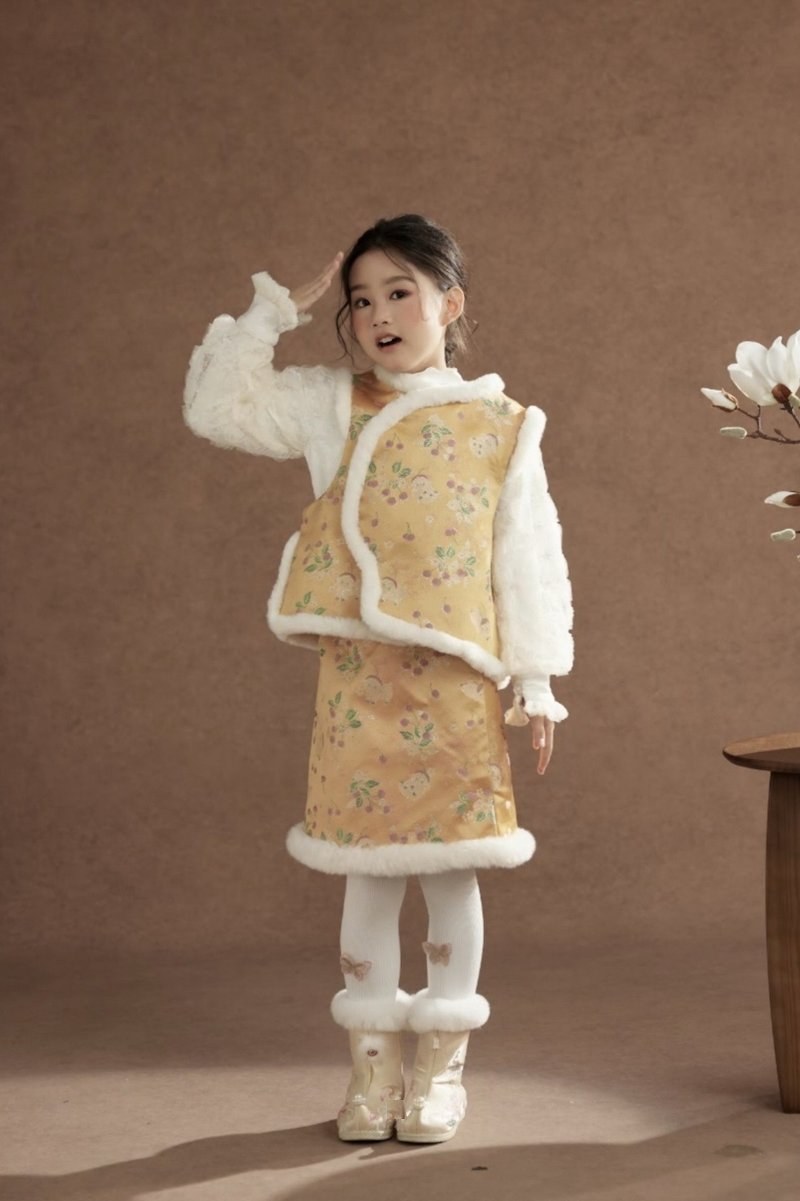
That goose-yellow cherry-jacquard set (SXY-DK26-34) is essentially qiuxiang translated into a washable plush a four-year-old can wear to a family lunch — history, but snack-proof history.
- Dailan 黛蓝 (indigo-ink blue): the deep blue of ink-wash landscape paintings. Song painters like Wang Ximeng, who painted the blue-green masterpiece A Thousand Li of Rivers and Mountains as a teenager, built entire worlds from blues and greens; a deep indigo vest carries the same gravity.
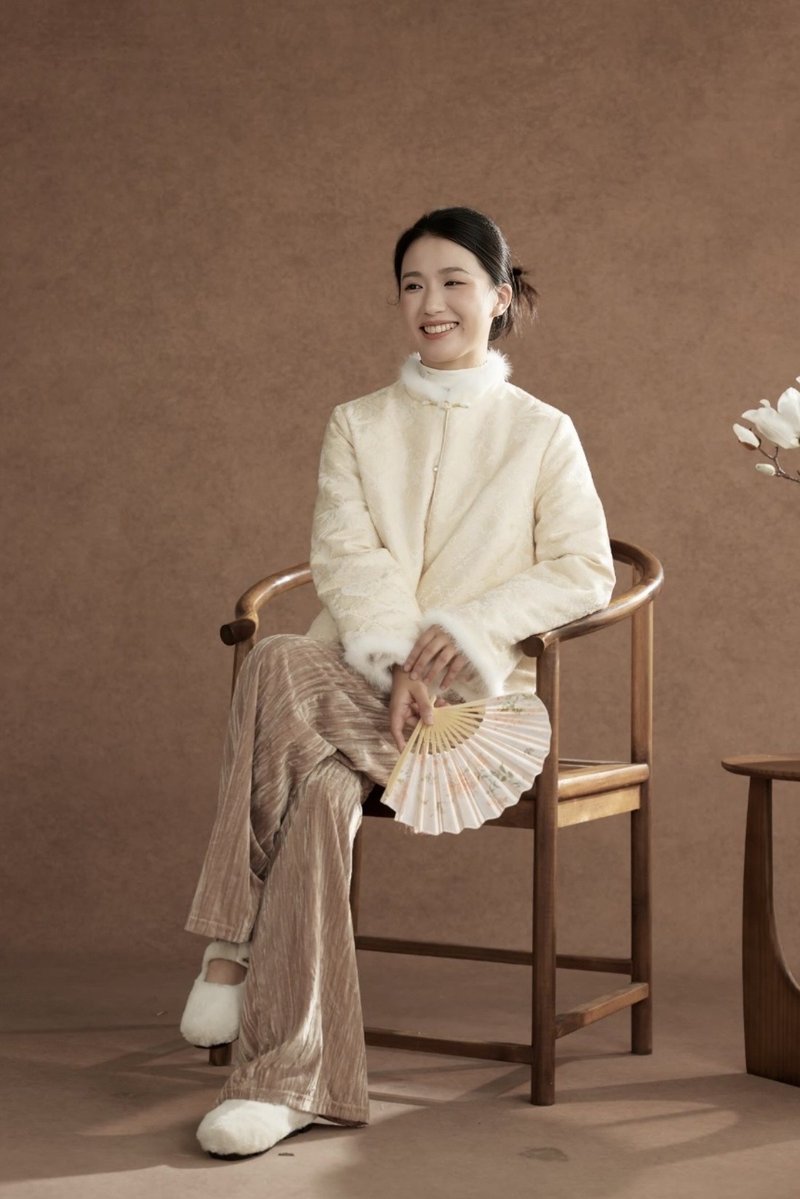
- Chajin / xiangjin 茶金·香槟 (tea-gold, champagne): the warm metallic beige of raw silk. This is the color most people today would not name as “traditional” at all — and that is exactly its charm. Our champagne velvet parent-child trousers live in this register: festive without announcing themselves.
What Song Colors Meant, Socially
Color in dynastic China was also a language of rank, and the Song codified it carefully. Deep purple and crimson marked the highest officials; blue and green the middle ranks; the commoner’s world ran on undyed cloth and practical blues. Children, importantly, were largely exempt from strict dress codes — which is one reason parents today can freely remix the palette. When you put a six-year-old in a lake-blue brocade vest, you are borrowing the dignity of a scholar’s formal blue; when you choose lotus pink, you are borrowing the soft high-rank purple and turning the volume down for a playground.
There is also a seasonal logic worth knowing. Song taste paired colors with the natural calendar: azure and moon-white for spring and clear days, lotus tones for early summer, autumn golds from late summer onward, indigo for winter depth. A modern kid’s capsule wardrobe can follow the same rhythm — which is one more reason the muted palette is more versatile than a wardrobe of festival red alone. Red still owns its moment, of course; our guide to why Chinese children wear red at New Year covers that story separately.
Why the Song Palette Works So Well for Children
Beyond heritage, there are purely practical reasons the muted palette suits kids:
- It hides real life. Champagne, tan, and grey-blue velvets show spills far less than stark white or saturated dyes.
- It pairs with clothes they already own. A pale blue vest over a school white tee is “traditional” without being costume; the same vest works over a turtleneck in December.
- It photographs calmly. Family photographers consistently prefer the desaturated end of the palette — saturated reds and golds bounce color onto faces in flash photography, while moon-whites and azures stay true.
- It survives trends. The Song look has cycled back into fashion roughly every generation for a thousand years. A camel-adjacent velvet trouser bought at age four still works at eight.
The Three Questions Every Parent Asks
Whichever color family you choose, the practical trio applies — here are the short answers, with full guides linked:
- Can it go in the machine? Most of the modern plush, knit, and velvet pieces in this palette are machine-washable on a gentle cold cycle inside a laundry bag; brocade jacquard prefers hand-washing. The full routine — drying, storage, and crease care — is in our wash and store guide.
- Is it safe against a child’s skin? Every children’s piece we sell is CNAS-lab-tested to GB31701-2015, China’s Class A infant and child textile standard, with no neck drawstrings on any garment. The checklist is in our toddler safety guide.
- Can they actually move? Yes — Song silhouettes were famously unfussy, and the modern versions keep it that way: elastic-backed waists, wide-leg trousers with generous rise, soft knits instead of stiff brocade at contact points. A child in a wide-leg velvet trouser can squat, climb, and sit cross-legged without a second thought.
Sizing the Palette to Your Child
Children’s sizes run by height in centimeters, from toddler to early teen (the collection covers roughly ages 2–14). Convert with this table before choosing any piece in the list above:
| Height (cm) | Closest US size | Typical age |
|---|---|---|
| 80 | 12–18 months | 1 year |
| 100 | 3T–4T | 3–4 years |
| 110 | 4T–5T | 4–5 years |
| 120 | 6–7 | 6–7 years |
| 130 | 8 | 8 years |
| 140 | 10 | 10 years |
| 150 | 12 | 12 years |
When a child sits between two heights, size up — the slim Song silhouette leaves room to grow without looking oversized, and hems on velvet trousers are easy to let down.
Frequently Asked Questions
Is a Song-style outfit the same as a tang suit?
No. “Tang suit” is a misnomer for a later Manchu-influenced jacket style; Song-style clothing means cross-collar or front-open layers in soft, muted fabrics. The full breakdown is in our hanfu vs qipao vs tang suit guide.
Will muted colors look dull on a child in photos?
Consistently the opposite. Low-saturation colors keep faces bright and let eyes carry the photo, which is why they dominate school-portrait and family-session styling advice. Add one saturated accessory — a red hair tie, a red envelope — if you want a focal point.
What colors should a child wear for Chinese New Year, then?
Red remains the festive standard, and there is real meaning behind it. But champagne and autumn-gold velvets are increasingly chosen by parents for the daytime between gatherings — festive-adjacent, washable, and easier to re-wear all winter.
Are these Song-named colors dyed safely?
Modern pieces use commercial reactive dyes bonded under the same GB31701 Class A testing regime that covers the fabric itself — a far stricter standard than historical mordant dyeing, which relied on mineral salts.
Where do we start if the whole family wants the look?
Start with bottoms, not tops: the champagne velvet wide-leg trousers in our parent-child trouser edit anchor both adult and children’s outfits, then layer pale vests and knits on top. The complete autumn-winter range is in the collection.