
Of all the outfits associated with Lunar New Year, the qipao is the one people picture first: a standing collar, a row of knotted frog buttons, a line of cloth falling straight and elegant. For a girl, wearing one at the New Year table is a small act of ceremony — she looks like the festival feels. Lunar New Year 2027 falls on Saturday, February 6, and if a qipao is on your list this year, the practical questions come quickly: what exactly counts as a qipao, how it differs from the hanfu dresses you may have seen, what size to order in a centimeter-based system, and how a light, graceful dress survives a February celebration. This guide answers all of it, with two complete looks from the collection and links to the deeper guides behind each step.
What a Qipao Actually Is
The qipao — also called the cheongsam — is the fitted, collared dress that became the signature of Chinese feminine dress in the1920s, with roots in earlier Manchu robes. Its signature details are consistent across a century of versions: a standing mandarin collar that frames the face, a diagonal placket closing at the side of the chest, knotted frog buttons (pankou) worked by hand from cloth, and a side slit or opening that lets the wearer walk freely. In adult wear it is tailored close to the body; in children’s wear, every good version relaxes those lines so a child can actually move. If the vocabulary of collars and closures is new to you, our hanfu, qipao and tang suit comparison draws the distinctions on one page.
One honest note on names: strictly speaking, the qipao is not hanfu — hanfu refers to the older Han Chinese dress traditions, while the qipao is a modern garment with its own story. The two sit side by side in Chinese family life, and at New Year both appear at the same table. Our collection interprets the qipao style for girls as a two-piece: an embroidered mandarin-collar tunic over a matching long skirt, which keeps the qipao’s collar, placket and frog buttons while giving children the ease of separates.
Two Qipao-Style Looks from the Collection
Both of these sets translate the qipao’s details into clothes a child can wear for hours.
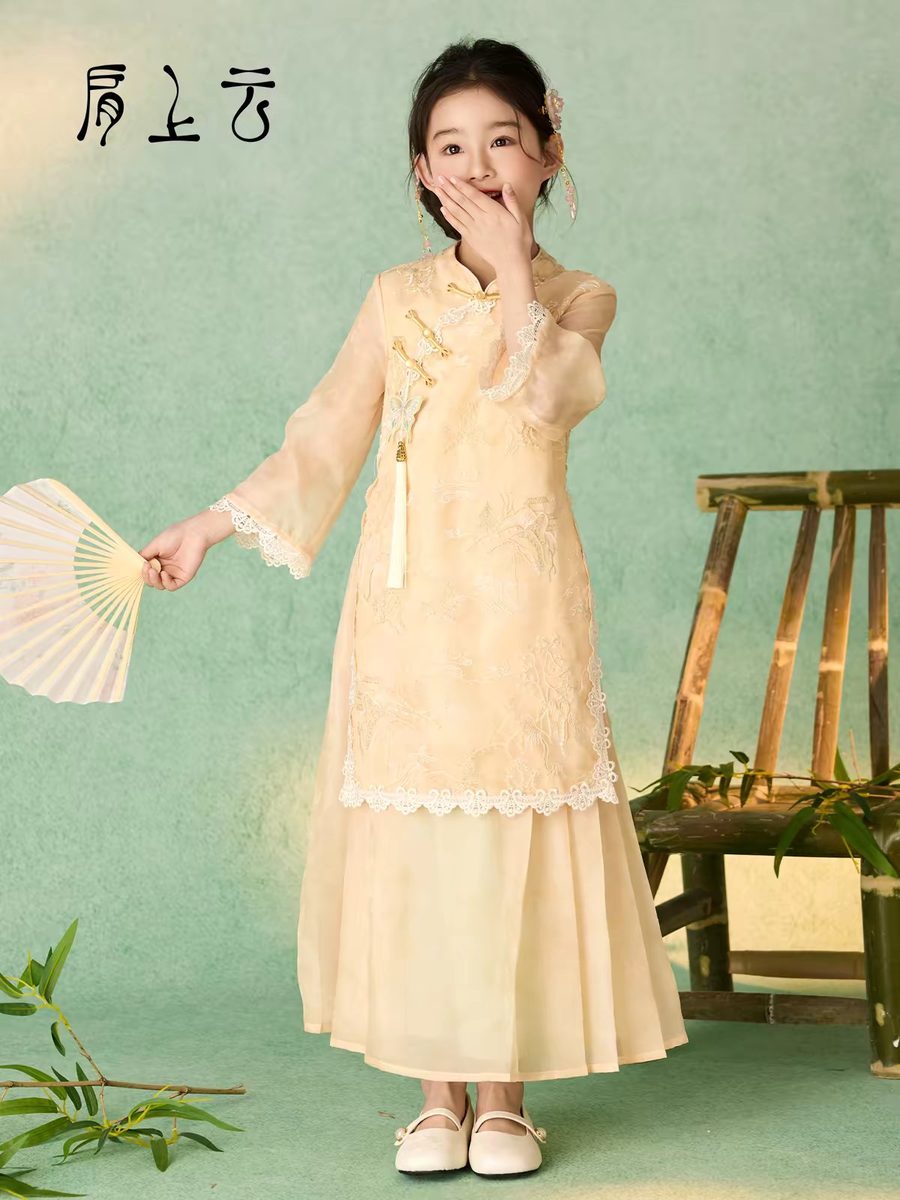
Look 1: Cream Yellow, the Quiet Festive Choice. The first is a cream-yellow embroidered set: a mandarin-collar tunic closing with gold frog buttons along a right-side diagonal placket, finished with a gold tassel at the closure and delicate floral embroidery across the front. White lace trims the cuffs and the tunic’s hem, and the tunic layers over a matching pleated skirt that falls to the ankle. Yellow-gold tones carry warmth and prosperity in the New Year palette, and the lighter shade photographs beautifully against red envelopes and lantern light — it stands out precisely because it is not another red dress.
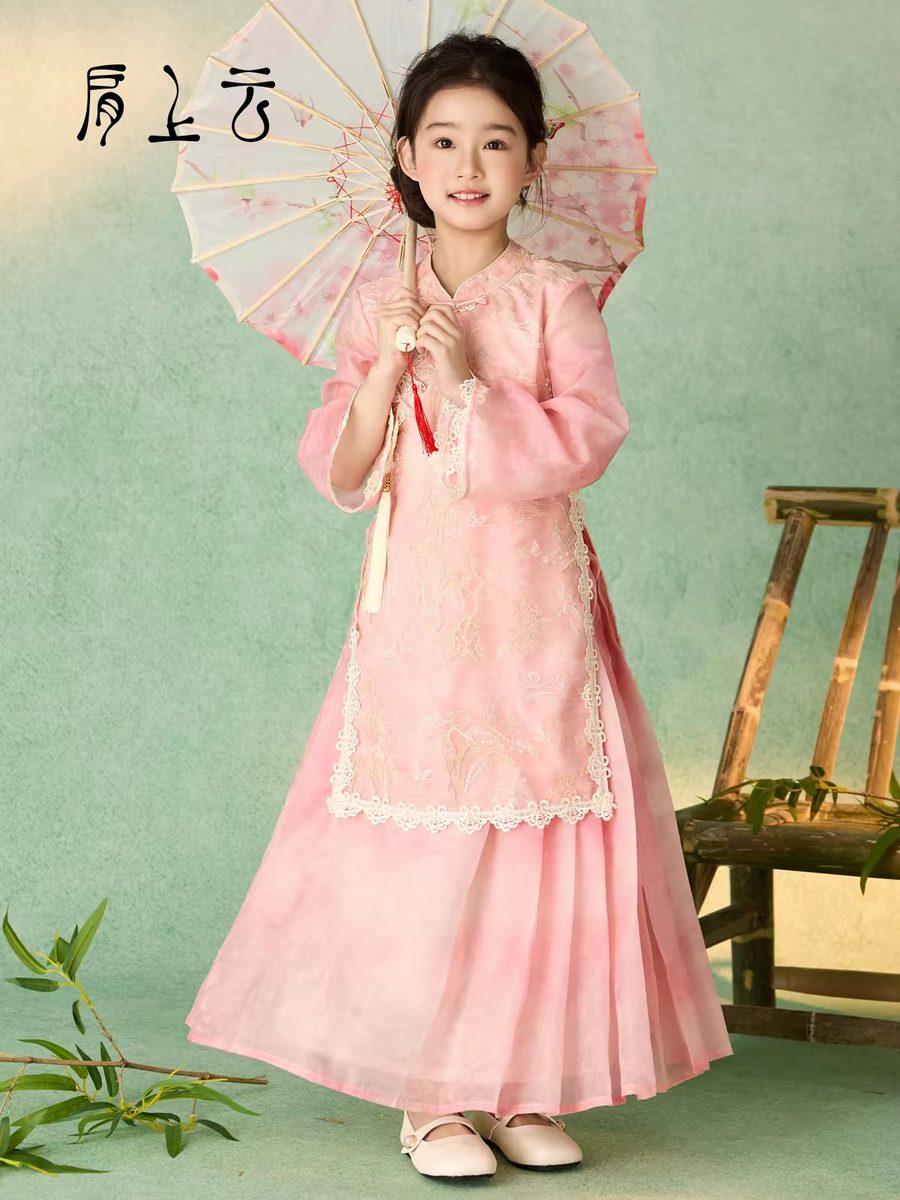
Look 2: Pink, the Soft Traditional Choice. The second set repeats the same architecture in a soft pink: a mandarin collar closed with a frog button at the neck, floral embroidery down the body, white lace at the cuffs and hem, a gold tassel, all over a pleated floor-length skirt in the same shade. Pink reads as joy and gentleness, it pairs naturally with the blossoms of the season, and like the yellow set it layers well over winter base clothes — more on that below.
If your daughter would rather wear the older dress traditions, the mamianqun guide for girls covers the horse-face skirt alternative, and our mamianqun explainer gives you the vocabulary to explain the difference at the dinner table.
Sizing: Measure Height in Centimeters First
Children’s sizes here are cut by height in centimeters; the US columns are translations, not the starting point. Measure your child without shoes and match the row — when you land on a boundary, size up, because hems carry growing room and a slightly longer line suits the occasion:
| Size tag (cm) | Child’s height | Approx. US age | Approx. US size |
|---|---|---|---|
| 90 cm | 85–95 cm | 2–3 years | 2T–3T |
| 100 cm | 95–105 cm | 3–4 years | 3T–4T |
| 110 cm | 105–115 cm | 4–5 years | 4T–5T |
| 120 cm | 115–125 cm | 6–7 years | US 6–7 |
| 130 cm | 125–135 cm | 7–9 years | US 7–8 |
| 140 cm | 135–145 cm | 9–10 years | US 10 |
| 150 cm | 145–155 cm | 11–12 years | US 12 |
| 160 cm | 155–165 cm | 13–14 years | US 14 |
The full cm-to-US sizing guide goes further, with torso and sleeve notes for each row.
Keeping a Light Dress Warm in February
The qipao-style sets are cut from light, semi-sheer fabric with embroidery on top — they are graceful first, warm second. February fixes that in two moves: a thin, snug base layer in cotton under the tunic (long sleeves disappear under the lace-trimmed cuffs), and fleece-lined tights or leggings under the pleated skirt. Indoors at a family dinner, that combination is usually all a child needs; outdoors between car and door, add a padded coat on top and it all comes off without disturbing the look. Our winter layering guide for kids’ hanfu walks through the full stack, and the Chinese New Year dinner outfit guide shows how these pieces sit alongside the padded winter sets in the same collection.
Movement: The Part Children Actually Notice
A dress a child cannot play in comes off in ten minutes, so test before the day: she should be able to squat, climb onto a chair and run across a room without holding the skirt. The two-piece construction earns its keep here — the tunic moves with the torso while the pleated skirt swings and never ties the knees together, and the relaxed fit through the chest means no tugging at the placket. If she passes the living-room test the night before February 6, the outfit will survive the whole reunion dinner.
Safety, Stated Plainly
The collection is produced to China’s GB31701-2015 Class A children’s textile safety standard — the strictest class, intended for garments worn against young children’s skin. The frog buttons are stitched through as traditional closures with no small detachable parts, and there are no drawstrings at the hood or neck anywhere in the range. Embroidery sits flat against the cloth rather than standing proud of it, so nothing snags. The complete pre-wear checklist is in our toddler safety checklist.
Care: Washing an Embroidered Dress
Embroidered, semi-sheer pieces prefer a gentle hand wash in cold water with mild detergent — soak briefly, swish, rinse, and hang or lay flat to dry away from direct sun. A gentle machine cycle in a laundry bag works for light refreshes, but skip the tumble dryer entirely; heat is unkind to both the embroidery threads and the sheer overlay. Blot any dinner-table spills promptly rather than rubbing. The full routine, including off-season storage in a breathable garment bag, is in our wash-and-store guide — and a set that leaves February in good condition will reappear at birthdays and weddings all spring.
When to Order for February 6
Lunar New Year 2027 falls on Saturday, February 6. In-stock pieces ship within days by DHL or FedEx; made-to-order styles take three to five weeks and bulk production six to ten, so an MTO order placed by mid-December arrives comfortably inside the January window. For the wider season plan, start with the early CNY outfit guide; and if you are dressing a boy as well, the wine-red brocade tang jacket spotlight is the natural counterpart to these dresses.
Frequently Asked Questions
Is a qipao the same as hanfu?
No, and the difference is worth knowing: hanfu is the umbrella for the older Han Chinese dress traditions, while the qipao is a modern garment that emerged in the 1920s with roots in earlier Manchu robes. Both are worn at New Year, and the comparison guide above shows the visual differences at a glance.
Can a non-Chinese family dress their daughter in a qipao for Lunar New Year?
Wearing a real garment from a living tradition, with its details intact and a willing child, is widely read as appreciation rather than caricature. The pitfall to avoid is a generic costume mashup with mismatched elements — a proper mandarin collar, frog buttons and side placket keep the garment authentic.
What size qipao should I buy for my daughter?
Match her height to the chart above — most four-year-olds wear 110 cm (105–115 cm tall, roughly US 4T–5T). When you land on a boundary, size up; the pleated skirts carry growing room gracefully.
How do I keep her warm in a light qipao-style dress?
Layer underneath: a snug cotton long-sleeve base under the tunic and fleece-lined tights under the skirt. Indoors that is usually enough; outdoors add a padded coat that comes off at the door. The winter layering guide covers the combinations row by row.
Can the dress go in the washing machine?
Gently, in a laundry bag, on a cold delicate cycle — but a hand wash keeps the embroidery and sheer overlay at their best, and never tumble dry. The wash-and-store guide has the full routine.
What should a boy wear to the same dinner?
The collection’s answer is the tang jacket — a mandarin-collar jacket in festive brocade over trousers. Our tang suit guide for boys covers the options, and the wine-red brocade jacket spotlight is this week’s featured piece.
A qipao at the New Year table is the kind of photograph grandparents keep forever. Measure her height, choose the shade that suits her, layer for the cold, and order inside the December window so the parcel beats February 6. The qipao-style sets, hanfu dresses and padded winter pieces are all on the collection page; the studio behind them is introduced on the about page; and boutiques building a New Year rail will find terms through the wholesale page.